LARP Event Narrative Pacing: Controlling the Rhythm of a Live Experience
Why LARP Pacing Is Different From Any Other Medium
Pacing a LARP event is unlike pacing a novel, a film, or even a tabletop game. You are not controlling a single narrative stream — you are orchestrating the emotional experience of dozens of players who are each living their own story simultaneously.
You cannot cut to the next scene. You cannot montage through boring parts. You cannot guarantee that a player will be in the right place at the right time for the emotional beat you planned. Your pacing tools are fundamentally different:
- Timing of events — When you trigger plot beats affects pacing
- NPC deployment — Where you send NPCs creates activity or calm
- Information release — When you reveal critical information affects urgency
- Environmental cues — Lighting, sound, and atmosphere signal shifts in intensity
- Physical space — Where events happen affects accessibility and energy
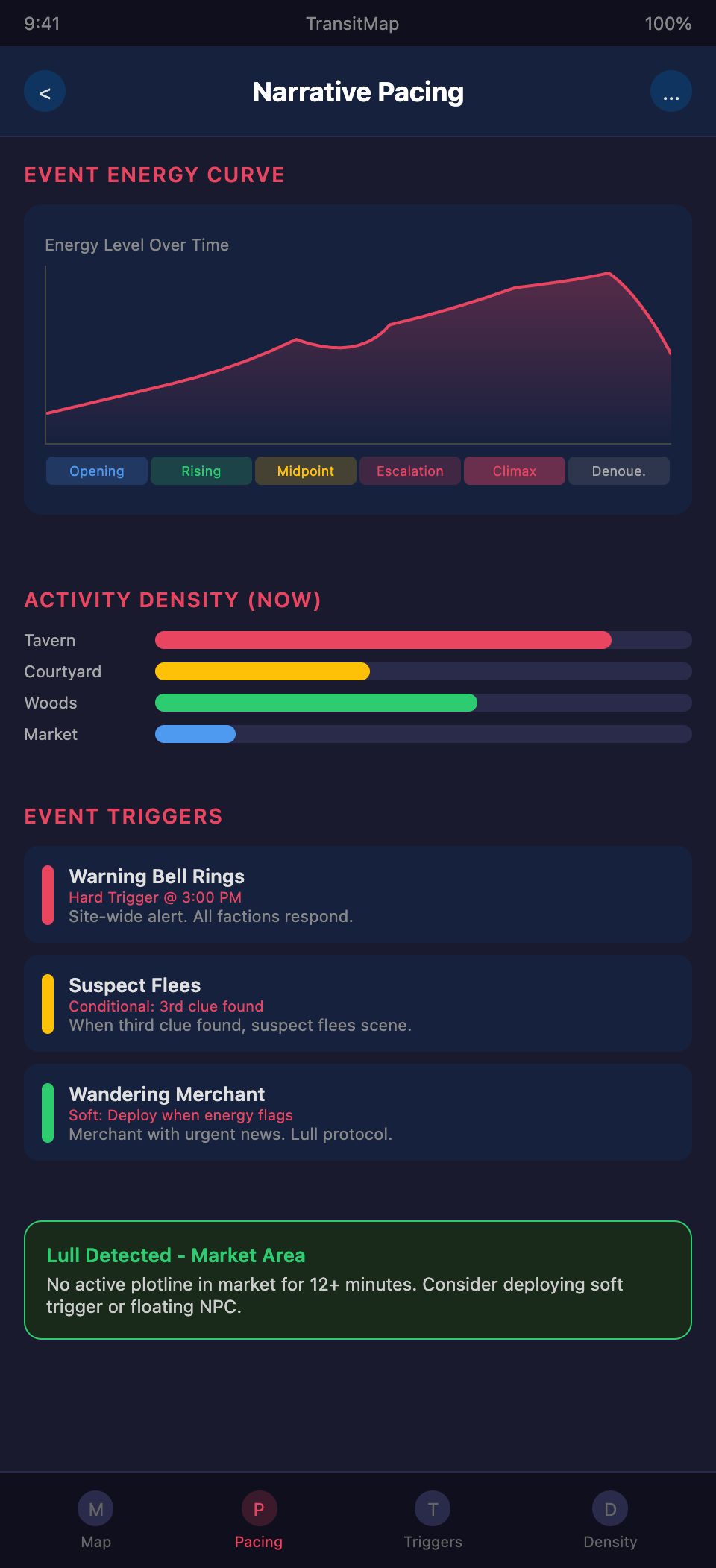
The Event Energy Curve
Plan your event's overall energy curve as a deliberate arc:
Opening (first 1-2 hours) — Low-to-moderate energy. Players arrive, settle into character, reconnect with allies, and explore the event space. Plotlines are seeded but not activated. NPCs deliver hooks and set expectations. This is your establishment phase.
Do not make the mistake of launching into high-intensity content immediately. Players need time to get into character, learn the space, and orient themselves. Starting with a bang leads to an event that peaks early and drags afterward.
Rising action (hours 2-5) — Moderate and building energy. Plotlines activate. Faction conflicts begin. Investigation threads produce early clues. Small confrontations occur. Players are making choices and forming plans. Each hour should feel slightly more intense than the last.
Midpoint shift (hour 5-6) — A significant event that changes the landscape. A revelation, a battle, a betrayal, or a crisis. This should be the event's most dramatic moment before the finale. It re-energizes players who may be flagging and sets up the second half.
Escalation (hours 6-8) — High energy. Plotlines converge. Faction conflicts intensify. Countdown clocks activate. Players are executing plans, fighting battles, and making critical decisions. Pacing should be tight — minimize dead time.
Climax (hours 8-9) — Maximum energy. The event's central conflict reaches its peak. The battle happens. The ritual is performed. The political crisis resolves. This should involve as many players as possible.
Denouement (final hour) — Descending energy. Aftermath scenes. Victory celebrations or mourning. Character moments. Quiet conversations. Let the event breathe before ending.
Pacing Tools for Live Events
Timed Event Triggers
Schedule key plot events at specific times to control the pacing rhythm:
- Hard triggers — Events that happen at a specific time regardless of player actions. "At 3 PM, the warning bell rings." "At sundown, the monster attacks." Hard triggers ensure pacing progresses even if players are not driving it.
- Conditional triggers — Events that happen when a condition is met. "When the third clue is found, the suspect flees." "When the alliance is brokered, the enemy sends an emissary." Conditional triggers respond to player progress.
- Soft triggers — Events that the lead storyteller activates when the pacing needs it. "When the energy is flagging, deploy the wandering merchant with urgent news." Soft triggers are your improv pacing tool.
Activity Density Control
Control pacing by managing how much is happening at any given time:
High density — Multiple plotlines active, NPCs deployed widely, events happening in multiple locations. Creates urgency and excitement. Use during the rising action and escalation phases.
Low density — Few active plotlines, NPCs consolidated, limited scheduled events. Creates calm and space for player-driven content. Use during the opening and denouement.
Variable density by location — Keep one area high-density (the tavern during a confrontation) while other areas remain low-density (the campfire for quiet conversations). This lets players choose their intensity level.
The Lull Protocol
Dead time at a LARP is the pacing killer. When nothing is happening, players disengage. Watch for lulls — periods of ten or more minutes where no plotline is active in any area — and deploy your response:
- Send a floating NPC with urgent news or a minor hook
- Trigger a soft event: a mysterious noise, a discovered item, an injured traveler
- Advance a ticking clock: announce that time is running out for something
- Create a social catalyst: send an NPC to start a conversation, make an accusation, or deliver an invitation
The goal is not to fill every moment with action. The goal is to prevent extended periods where players have nothing to engage with.
Player-Driven Pacing
Not all pacing is organizer-controlled. Players drive pacing through their choices:
Fast players will rush through content, reaching plot beats ahead of schedule. Let them. Do not slow them down artificially. Instead, have additional content ready — deeper investigation, secondary objectives, complications that add richness without gating progress.
Slow players will linger on scenes, explore thoroughly, and engage in extended roleplay. Let them, up to a point. If their pace is delaying content for other players, use narrative pressure — an NPC interrupts with urgent news, a deadline approaches, a consequence of inaction manifests.
Player-created content — Some of the best LARP moments are scenes that players create entirely on their own: impromptu trials, philosophical debates, romantic encounters, training montages. These are signs of a healthy event. Do not interrupt them with plot content unless time-critical beats are at risk.
Pacing Across Multi-Day Events
For events spanning two or more days, pacing operates on a macro scale:
Day 1: Establishment and rising action. End the day with a dramatic cliffhanger — an unresolved battle, a stunning revelation, or a crisis that demands action tomorrow.
Night: If the event runs overnight, this is high-tension territory. Night scenes in LARP carry inherent atmosphere — darkness, reduced visibility, heightened senses. Use night for horror elements, covert operations, and intimate character moments.
Day 2: Escalation and climax. Begin with the consequences of Day 1's cliffhanger. Build steadily toward the event's climax. End with resolution and denouement.
The overnight transition is a natural pacing tool — players sleep (or do not) and return with renewed or diminished energy. Plan your Day 2 opening to match their likely energy state.
Want to map your LARP event's pacing as a visual timeline with energy curves and trigger points? Join the TransitMap waitlist — plan your event's rhythm like a transit schedule, with express runs for high-intensity moments and local stops for quiet scenes.