LARP Mystery Plotline Clue Management: Designing Solvable Mysteries for Live Events
Why LARP Mysteries Are Uniquely Difficult
Mystery plotlines at LARP events face challenges that tabletop mysteries do not:
- No GM narration — You cannot describe what a player notices. They must physically find clues or extract information from NPCs through conversation.
- Parallel investigators — Multiple players may be investigating simultaneously, sharing (or hoarding) information unpredictably.
- Real-time pressure — The event ends at a fixed time. If the mystery is not solved by then, it simply is not solved.
- Physical distribution — Clues exist in physical space. A prop placed in the wrong location or an NPC who wanders away from their post can break the investigation chain.
- Player-to-player information transfer — You cannot control whether players share clues with each other. Information might pool in one player who is not actively investigating, or scatter across twelve players who never compare notes.
Despite these challenges, mystery plotlines are among the most popular LARP content types. Players love the thrill of investigation, deduction, and the moment when the pieces click into place.
The LARP Clue Distribution System
Physical Clues
Props, documents, and items placed in the game world for players to discover:
- Placement — Physical clues must be in locations players will actually visit. A clue hidden in an obscure corner of the site will never be found. Place clues in high-traffic areas or in locations tied to other active storylines.
- Discoverability — Clues should be findable through reasonable effort. A sealed letter on a desk is discoverable. A letter hidden inside the binding of a book on a shelf of fifty books requires either a very specific hint or pure luck.
- Durability — Physical props can be damaged, lost, or stolen by players who do not realize they are clues. Use durable materials. Make copies of critical documents. Mark props clearly if they should not be removed from a location.
- Chain protection — If Clue B is hidden inside an object that can only be opened with the key from Clue A, what happens if someone opens the object by force or steals it? Protect critical chains by ensuring alternative discovery paths.
NPC-Delivered Clues
Information that NPCs share with investigating players:
- Trigger conditions — What must a player do or say to receive the clue? "Ask about the night of the murder" or "show the NPC the evidence from the crime scene." Be specific in your NPC briefs so the NPC knows when to reveal information.
- Graduated revelation — NPCs should not dump all their information at once. First conversation reveals basic information. Follow-up questions reveal deeper details. Returning with corroborating evidence reveals the most sensitive information.
- Consistency — Every player who meets the trigger conditions should receive the same information. If the NPC tells Player A about the suspect's alibi but forgets to tell Player B, the investigation becomes unfair. Written NPC briefs with explicit "if asked about X, say Y" instructions prevent this.
Environmental Clues
Things players observe in the game environment:
- Scene dressing — The crime scene should tell a story through its physical arrangement. A knocked-over chair. A broken window. A bloodstain. Players who examine the scene carefully should be rewarded with deducible information.
- Ambient information — NPCs in the background discussing the event. Posted notices with relevant information. A clock that establishes the timeline. These clues are available to attentive players without requiring active investigation.
The Three-Clue Rule for LARP
The standard three-clue rule (design three clues for every conclusion) applies to LARP with a crucial modification: in LARP, you need five clues for every conclusion.
Why five instead of three?
- Physical clues can be lost, damaged, or stolen
- NPC clues can be forgotten or garbled by crew members under pressure
- Players may find clues but not share them with investigators
- Players may find clues but misinterpret them
- Players may never visit the location where a clue is placed
With five clues per conclusion, you have redundancy for the many ways LARP can disrupt information flow.
Tracking Clue State During the Event
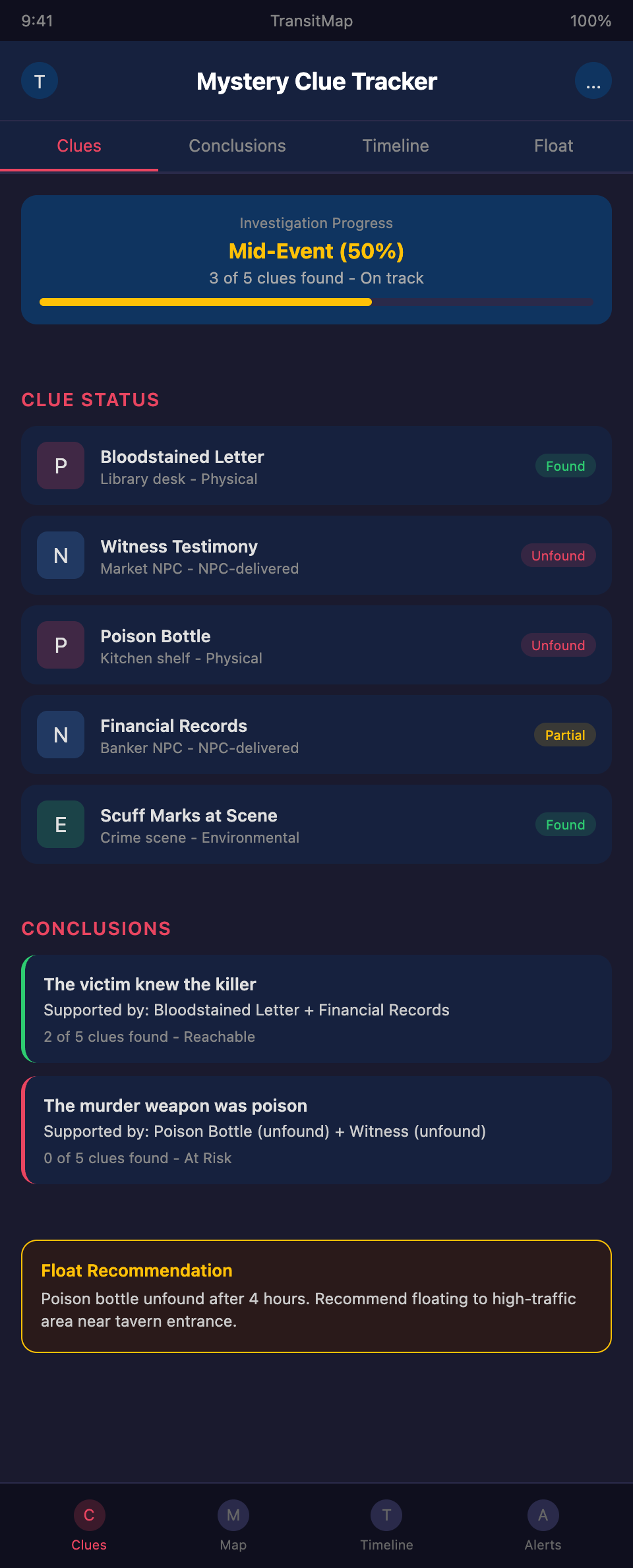
Maintain a clue tracker that your mystery line storyteller monitors throughout the event:
| Clue | Location | Type | Status | Found By | Conclusion It Supports |
|---|---|---|---|---|---|
| Bloodstained letter | Library desk | Physical | Found | Player A | The victim knew the killer |
| Witness testimony | Market NPC | NPC-delivered | Not yet triggered | — | The victim was seen arguing |
| Poison bottle | Kitchen shelf | Physical | Not found | — | The murder weapon was poison |
| Financial records | Banker NPC | NPC-delivered | Partially revealed | Player C | The suspect had motive |
| Scuff marks at scene | Crime scene | Environmental | Not noticed | — | There was a struggle |
At any time during the event, the mystery storyteller can see:
- Which clues have been found
- Which conclusions have enough found clues to be reachable
- Whether any conclusion has all its clues unfound (requiring intervention)
The Floating Clue Technique for LARP
When critical clues remain unfound, float them — move them to where the investigating players are:
- The unfound physical clue "falls out of a book" that a player picks up in a nearby location
- An NPC approaches the investigators with information they "just remembered"
- A crew member playing a background character mentions relevant gossip within earshot of the investigators
Floating clues should be delivered naturally. If it is obvious that the organizer is feeding the players answers, the mystery loses its satisfaction.
Managing the Investigation Timeline
LARP mysteries need to resolve within the event's timeframe. Build timeline management into your design:
Early event (25%): Plant all clues. Seed the mystery hook. Players should discover the mystery and begin investigating.
Mid event (50%): Most clues should be findable. Players should have enough information to form theories. If investigation is stalling, begin floating unfound clues.
Late event (75%): Players should be approaching the solution. The mystery should feel solvable. If they are still stuck, deploy NPC hints or consolidate scattered information.
Pre-climax (90%): The solution should be within reach. The final clue or the final deduction should happen at a dramatically appropriate moment.
Climax: The reveal. The confrontation with the culprit. The resolution.
If your mystery is not on track at the 50% mark, intervene. Do not wait until the end of the event to discover that the mystery was unsolvable.
Designing a mystery plotline for your next LARP event? Join the TransitMap waitlist — map every clue, conclusion, and investigation path as a transit network, with real-time status tracking so you always know if your mystery is on track.