LARP NPC Motivation Tracking: Making Every Character Feel Real
The Motivation Problem
Most LARP NPCs are designed as functions: the quest giver, the informant, the merchant, the enemy combatant. They exist to serve a storyline purpose, and once that purpose is fulfilled, they become empty shells — standing around with nothing to do, breaking immersion every time a player tries to interact with them beyond their scripted role.
The fix is not writing longer backstories. It is giving every NPC a motivation — a clear, actionable want that drives their behavior in every situation, scripted or not. An NPC with a motivation can improvise. An NPC without one can only recite lines.
What Makes a Good NPC Motivation
A useful NPC motivation is:
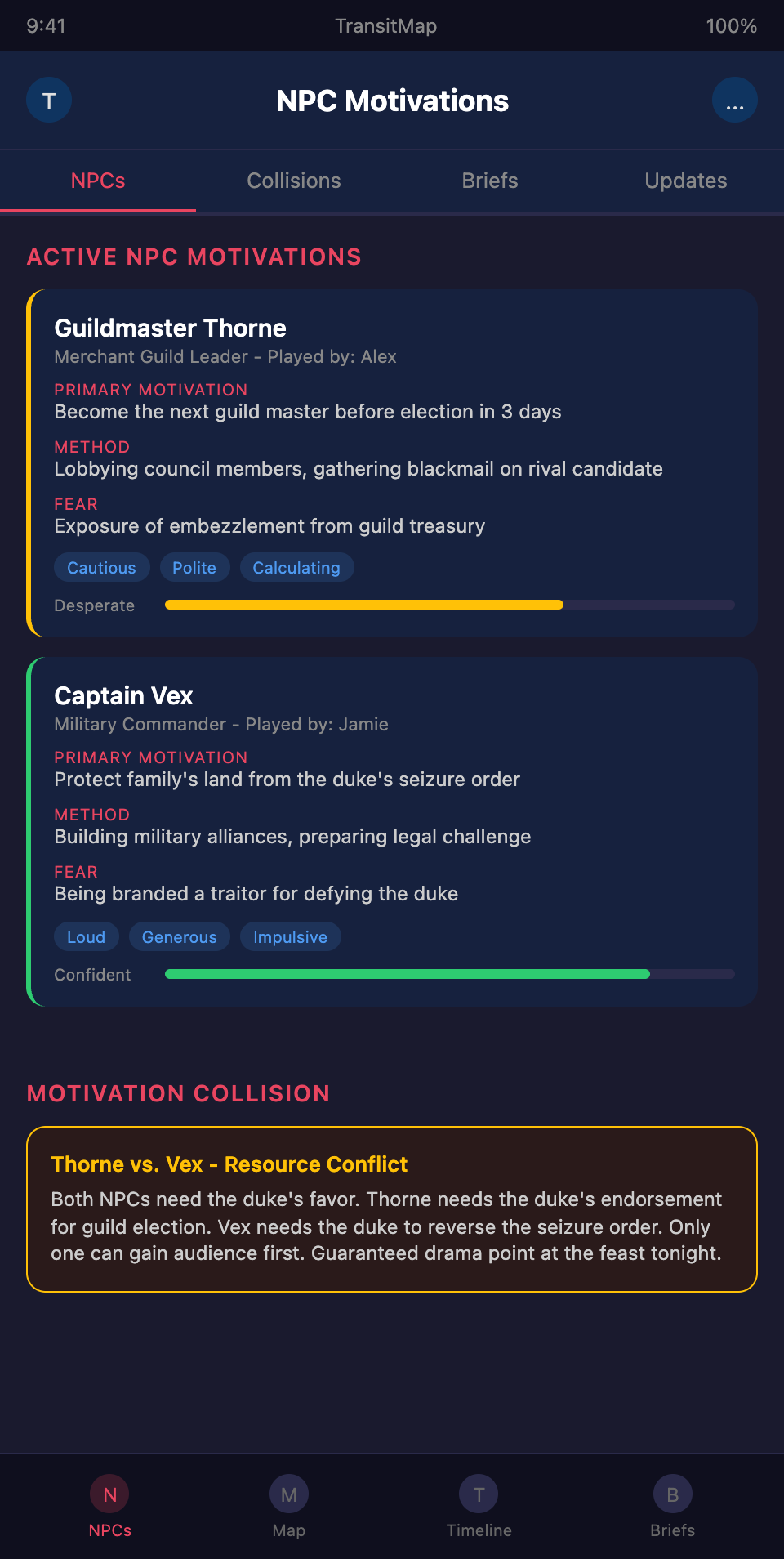
Specific. Not "wants power" but "wants to become the next guild master before the election in three days." Specific motivations generate specific actions.
Active. Not "is sad about the past" but "is looking for the person who betrayed her family." Active motivations drive the NPC to do things, not just feel things.
Relevant. The motivation should intersect with active storylines or player interests. An NPC whose motivation is entirely disconnected from everything else happening at the event is a narrative island.
Conflictable. The motivation should create potential conflict — with other NPCs, with player goals, or internally within the NPC. Conflict generates story.
Achievable within the event. If the NPC's motivation cannot possibly be fulfilled during the event, the NPC will feel frustrated and static. Even partial progress toward the motivation keeps the NPC dynamic.
The Motivation Brief Format
For each NPC, write a motivation brief — a concise document that any crew member can read in three minutes and use to play the character authentically:
Name and role: [Character name] — [One-line description of their role in the event]
Primary motivation: What do they want most? One sentence.
Method: How are they trying to get it? What is their current plan?
Fear: What outcome are they trying to avoid? This drives defensive behavior.
Relationships: Who do they trust? Who do they distrust? Who are they trying to impress? (3-5 relationships maximum)
Knowledge: What do they know that is relevant to active storylines? What do they NOT know?
Behavioral guide: Three adjectives that define how they interact with others. "Cautious, polite, calculating." "Loud, generous, impulsive."
Trigger reactions: How do they react to specific situations?
- If confronted with evidence of their secret: [reaction]
- If offered a deal: [reaction]
- If threatened: [reaction]
- If their motivation is blocked: [reaction]
Tracking Motivation State During Events
NPC motivations are not static. As the event progresses, NPCs should be affected by events, player actions, and other NPCs' actions. Track each NPC's motivation state:
Progress toward motivation: Has the NPC made progress? Have they suffered setbacks? Is the motivation still achievable?
Emotional state: Based on events so far, how is the NPC feeling? Confident? Desperate? Suspicious? This affects their behavior in the next scene.
Relationship changes: Has any interaction changed the NPC's trust or attitude toward a player or another NPC?
Knowledge updates: Has the NPC learned anything new that affects their motivation or behavior?
Update NPC motivation states at your regular check-in intervals. The line storyteller responsible for the storyline should track NPCs within their storyline. The lead storyteller tracks cross-storyline NPCs.
Crew Briefing for Motivated NPCs
When briefing crew members to play motivated NPCs:
Teach the motivation, not the script. Instead of "when the player asks about the key, say this line," teach "your character is trying to protect the key because it unlocks the vault where your family's fortune is stored. You will resist giving it up unless the player can convince you that the vault is in danger."
Encourage improvisation within bounds. A crew member who understands the NPC's motivation can handle any player interaction, including ones the organizer did not anticipate. Set the boundaries (what the NPC knows, what they will never reveal, what they would die for) and let the crew member inhabit the character.
Role-play the NPC with them. Before the event, spend five minutes in conversation with the crew member while they are in character. Ask questions about their motivation. Challenge them with hypothetical player actions. This rehearsal is more valuable than a twenty-page backstory document.
Check in during the event. Between scenes, briefly check in with crew members playing major NPCs. "How is your character feeling right now? Has anything changed?" This keeps the NPC's emotional state current and prevents the crew member from defaulting to their initial briefing state.
When Motivations Collide
The richest LARP moments happen when NPC motivations collide — with each other or with player goals:
NPC vs. NPC motivation collisions: Two NPCs want the same thing but only one can have it. Two NPCs need each other's help but have conflicting methods. These collisions create drama without any player involvement — but players who witness or involve themselves in NPC conflicts become deeply engaged.
NPC vs. player motivation collisions: The NPC's goal conflicts with a player's goal. The NPC is a full character who will resist, negotiate, deceive, or fight to achieve their motivation. This is where LARP becomes genuinely interactive — not players versus a script, but players versus a motivated character.
Design at least two or three explicit motivation collisions into every event. These are your guaranteed drama points.
Common NPC Motivation Mistakes
- Motivation without action — The NPC wants something but never does anything about it. Motivations must drive visible behavior.
- Too many motivations — An NPC with five motivations is an NPC with no clear direction. One primary motivation with one secondary is enough.
- Motivation disconnect — The NPC's motivation has nothing to do with anything happening at the event. Every motivation should connect to at least one active storyline.
- Unchanging motivation — The NPC wants the same thing from the first minute to the last, regardless of what happens. Motivations should evolve — a desperate NPC who achieves safety shifts to a different motivation.
- Player-invisible motivation — The NPC's motivation is so secret that no player can ever discover or interact with it. Motivations should be discoverable through observation, conversation, or investigation.
Want to track every NPC's motivation, state, and evolution across your LARP events? Join the TransitMap waitlist — map NPC arcs as transit lines with motivation milestones, relationship nodes, and emotional state markers that update in real time.