LARP NPC Scheduling and Management: Getting the Right People in the Right Place
The NPC Scheduling Crisis
In tabletop gaming, the GM plays every NPC. In LARP, NPCs are played by crew members — real people with limited energy, time, and the ability to be in only one place at once. Every LARP organizer has experienced the moment when a critical NPC fails to appear because the crew member was double-booked, stuck in another scene, or simply lost in the woods.
NPC scheduling failures are not just inconvenient. They break plotlines. If the mysterious informant never shows up, the investigation stalls. If the villain does not arrive for the confrontation, the dramatic climax fizzles. If the quest giver is missing, twenty players have nothing to do.
Preventing these failures requires a systematic approach to NPC scheduling that treats crew members as a finite resource to be allocated carefully.
Mapping Your NPC Requirements
Start by listing every NPC role required for your event:
Permanent roles — NPCs who exist throughout the entire event. Faction leaders, shopkeepers, tavern staff, guards. These require crew members who are committed for the full event duration.
Scheduled roles — NPCs who appear at specific times for specific scenes. The mysterious messenger who arrives at dusk. The rival guild leader who appears for the negotiation. The monster that attacks at midnight. These require crew members at specific times.
Reactive roles — NPCs who appear in response to player actions. The guards who respond to a crime. The healer who is summoned. The spy who follows a player. These require crew members on standby.
Modular roles — NPCs who can be played by different crew members at different times. Generic guards, merchants, or villagers whose specific identity does not matter. These are your flexible roles.
Building the NPC Schedule
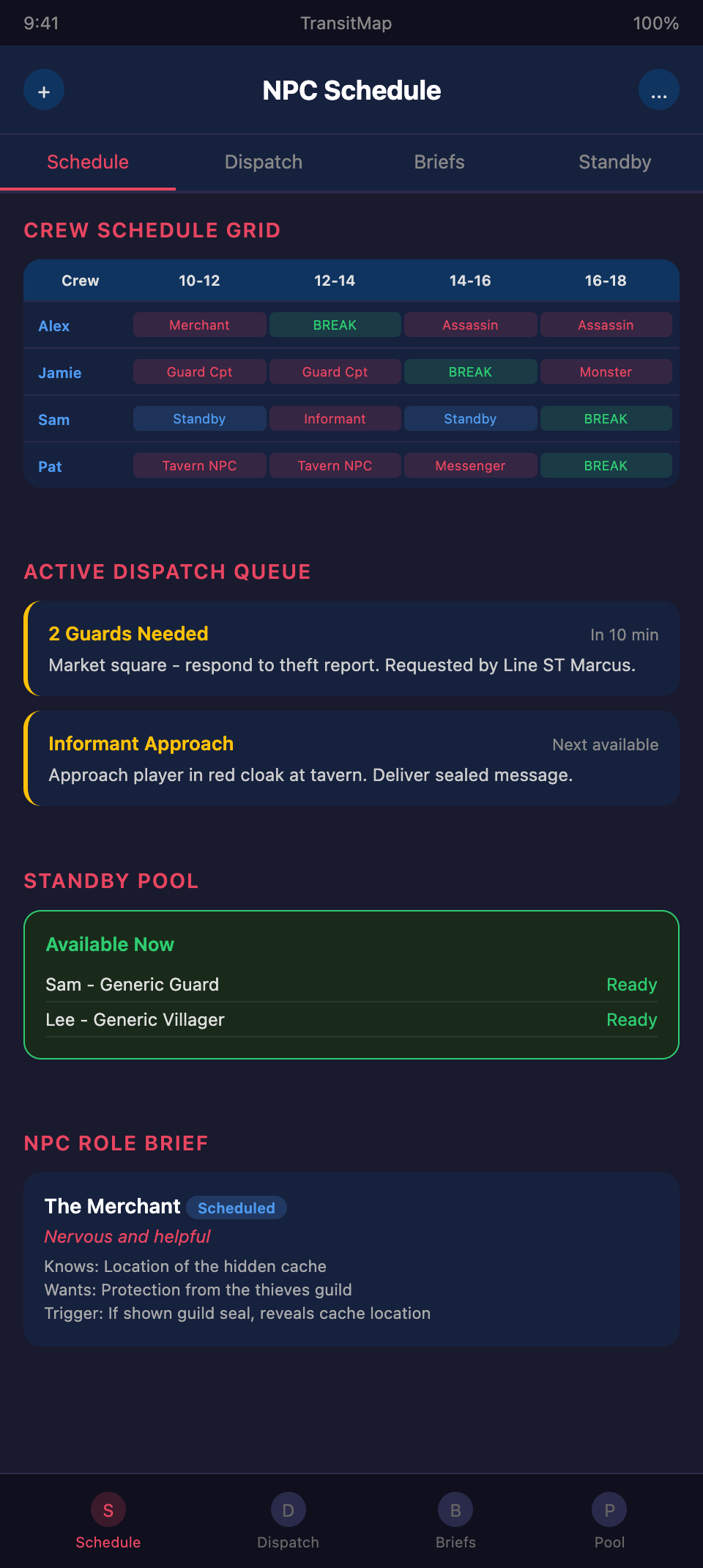
Create a schedule grid that maps crew members against time slots:
| Crew Member | 10:00-12:00 | 12:00-14:00 | 14:00-16:00 | 16:00-18:00 |
|---|---|---|---|---|
| Alex | Merchant (tavern) | BREAK | Assassin (courtyard) | Assassin (various) |
| Jamie | Guard Captain (gate) | Guard Captain (gate) | BREAK | Monster crew |
| Sam | Available (standby) | Informant (library) | Available (standby) | BREAK |
Critical rules for the schedule:
Every crew member gets breaks. Playing NPCs is physically and emotionally demanding. Schedule mandatory breaks of at least one to two hours for every four hours of play. Burned-out crew members give flat performances that undermine your storylines.
Buffer between role changes. If a crew member switches from one NPC role to another, allow at least thirty minutes between roles for costume changes, briefing, and mental reset. A crew member who rushes from playing a beggar to playing a noble will not sell either role.
No crew member should play conflicting roles in the same storyline. If players might interact with both NPCs in the same context, they should be played by different crew members to prevent immersion breaks.
Identify single points of failure. Any NPC role that only one crew member can play is a vulnerability. If that crew member gets sick, injured, or unavailable, the storyline is stranded. For critical roles, have a backup crew member who knows the character and can step in.
The Role Brief System
Each NPC role needs a written brief that any crew member can pick up and play. The brief should include:
- Character name and appearance — What do they look like? What costume pieces define them?
- Personality in three words — Nervous and helpful. Arrogant and dismissive. Friendly but evasive.
- Key information they know — What can they tell players? What should they withhold?
- Key information they want — What are they trying to learn from player interactions?
- Trigger conditions — What player actions or events should trigger specific responses?
- Escalation protocol — What does this NPC do if threatened, bribed, charmed, or attacked?
- Off-limits actions — What should this NPC never do or reveal?
A good brief is one page, maximum. Crew members should be able to read it in five minutes and play the role competently. Save detailed backstories for permanent roles played by experienced crew members.
Real-Time NPC Dispatch
During the event, maintain a dispatch system for reactive NPCs:
The dispatch board — A central location (or group chat) where line storytellers can request NPCs. "Need two guards at the market in ten minutes." "The informant needs to approach the player in the red cloak at the tavern."
The dispatcher — One crew member (often the lead storyteller or a designated coordinator) who receives requests, checks the schedule for available crew, and dispatches them. The dispatcher is the single point of contact for all NPC requests.
The standby pool — Two to three crew members who are available at any time for reactive roles. They have modular costumes (generic villager, guard, merchant) and can be dispatched quickly. The standby pool rotates — nobody should be on standby for more than two hours before getting a scheduled role or a break.
Common NPC Scheduling Mistakes
Over-scheduling crew. Giving every crew member back-to-back roles with no breaks. This leads to exhaustion, flat performances, and crew members who resent the experience.
Under-briefing. Sending a crew member into a scene with verbal-only instructions: "You're a merchant, just sell stuff." Crew members need written briefs with specific information about what they know, what they want, and what they should do.
Ignoring travel time. Your event site is large. The crew member playing the forest hermit cannot teleport to the tavern for the next scene. Factor in walking time between locations.
No contingency for no-shows. Crew members get sick, have emergencies, or simply do not show up. For every critical NPC, have a plan B: a backup crew member, a modified scene that does not require the NPC, or a way to delay the scene until the NPC is available.
Forgetting crew are players too. Many crew members participate in LARPs because they enjoy the experience. If they spend the entire event playing generic guards with no meaningful interactions, they will not come back. Give every crew member at least one role that is fun, dramatic, or satisfying.
Scaling NPC Management
Small events (10-20 players, 3-5 crew): A simple printed schedule and verbal communication is sufficient. The organizer can manage NPC dispatch personally.
Medium events (20-50 players, 5-15 crew): A formal schedule grid, written briefs, and a designated dispatcher become necessary. Communication via group text or walkie-talkies.
Large events (50+ players, 15+ crew): Full operations framework with lead storyteller, line storytellers, floating crew, a dispatch board, and a communication system. Written briefs for every role. Backup plans for every critical NPC. Post-event debrief on NPC performance.
Ready to schedule and dispatch your LARP NPCs without the chaos? Join the TransitMap waitlist — map every NPC role as a scheduled stop on your event's storyline routes, with crew assignments, timing, and dispatch all in one visual system.