Managing Player Faction Conflicts at LARP Events
Why Faction Conflict Is Essential to LARP
Faction conflict drives LARP storytelling the way gravity drives orbits. Without competing interests between player groups, a LARP event becomes a cooperative experience where everyone works together against a GM-controlled threat. That can be fun, but it lacks the unpredictability, betrayal, and political maneuvering that makes LARP uniquely engaging.
Well-managed faction conflict creates:
- Player-driven drama that does not require constant GM input
- Meaningful choices with real consequences within the game world
- Emergent storylines that no organizer could have scripted
- Deep roleplay opportunities around loyalty, betrayal, negotiation, and compromise
- Replayability — every event plays out differently because faction dynamics are never the same
But poorly managed faction conflict creates:
- Out-of-game resentment between player groups
- Power imbalances where one faction dominates and others feel helpless
- Stagnation where factions settle into fixed positions and nothing changes
- New player exclusion where faction dynamics are so entrenched that newcomers cannot participate meaningfully
Designing Faction Conflicts
Effective faction conflicts start with design. Each faction should have:
A clear goal — What does this faction want? Territory, power, resources, justice, revenge, protection? The goal should be specific enough that progress is measurable.
A legitimate claim — The faction's position should be at least partially sympathetic. Even the "villain" faction should have reasons that make sense. If one faction is obviously right and another is obviously wrong, there is no real conflict — just a morality play.
Incompatible interests — Faction goals should conflict naturally. Two factions cannot both control the same territory. Two factions cannot both have the council's ear on the same issue. The conflict should arise from the situation, not from arbitrary antagonism.
Resources and leverage — Each faction should have assets that the others need or fear. Military strength, political connections, information, magical capabilities, popular support. Asymmetric resources are fine — even desirable — but no faction should have nothing.
Internal complexity — Within each faction, there should be differing opinions. Hawks and doves. Traditionalists and reformers. This prevents factions from acting as monolithic blocks and creates space for individual player agency within the faction.
Balancing Faction Power
The most common faction conflict problem is power imbalance — one faction is clearly stronger than the others, which makes the conflict feel predetermined.
Prevention measures:
- Balanced starting positions — Each faction starts the event with roughly equivalent total power, though the form of that power may differ (one has soldiers, another has wealth, another has information)
- Balancing mechanisms — Built-in mechanics that prevent runaway advantage. The faction that controls the most territory faces rebellion. The faction that amasses the most wealth attracts thieves. Power creates vulnerability.
- External pressures — Threats that affect all factions create temporary alliances and prevent any one faction from focusing solely on dominating the others
- Information asymmetry — Each faction has secrets that give them advantages in specific situations. The faction that seems weakest might have the most critical information.
Intervention measures (use sparingly):
- Narrative boosts — A faction that is struggling receives unexpected aid: a new ally, a discovered cache of resources, or a piece of information that shifts the balance
- Complications for the dominant faction — Internal dissent, supply problems, or external threats that demand the dominant faction's attention and prevent them from pressing their advantage
- Neutral NPCs with agendas — NPCs who are not aligned with any faction but whose actions affect the balance. A neutral merchant who sells to the highest bidder. A neutral judge who rules impartially.
Refereeing Faction Conflicts
During events, faction conflicts need active refereeing:
Rules of engagement. Establish clear rules for how factions can conflict:
- What actions require a referee present? (Combat, theft, assassination attempts)
- What actions can happen without oversight? (Negotiation, espionage, social manipulation)
- What actions are prohibited? (Out-of-game intimidation, rule abuse, targeting players rather than characters)
Dispute resolution. When factions disagree about what happened — "I stabbed you!" "No, I dodged!" — have a clear resolution process:
- Referee makes an immediate ruling based on available evidence
- Both parties agree to abide by the ruling during the event
- Disputes can be reviewed after the event for future policy adjustments
- The in-game result stands regardless of the review outcome
Escalation management. Monitor faction conflicts for signs of unhealthy escalation:
- Players using out-of-game information for in-game advantage
- Players targeting the same individual repeatedly (feels like bullying)
- Players refusing to separate character feelings from player feelings
- One faction systematically shutting another out of all content
Intervene early when these signs appear. A quiet conversation with the relevant players usually resolves the issue before it becomes a crisis.
Keeping Faction Conflicts Dynamic
Static faction conflicts are boring. If the three factions maintain the same positions for three events, the conflict has become wallpaper. Keep it dynamic:
Shift alliances. Create situations that encourage factions to realign. The enemy of the first event might become the ally of the second event if circumstances change.
Introduce new stakes. Each event should introduce a new resource, territory, or issue that factions must compete over. This prevents the conflict from settling into a rut.
Resolve old conflicts. Let some faction disputes reach a conclusion. If two factions have been fighting over a trade route for three events, resolve it — and introduce a new source of conflict to replace it.
Change faction leadership. Encourage player-driven leadership changes within factions. New leaders bring new priorities and new approaches that reshape inter-faction dynamics.
Add neutral players. Characters who are not aligned with any faction can serve as wildcards — mercenaries, diplomats, or independent agents who shift the balance unpredictably.
Tracking Faction State
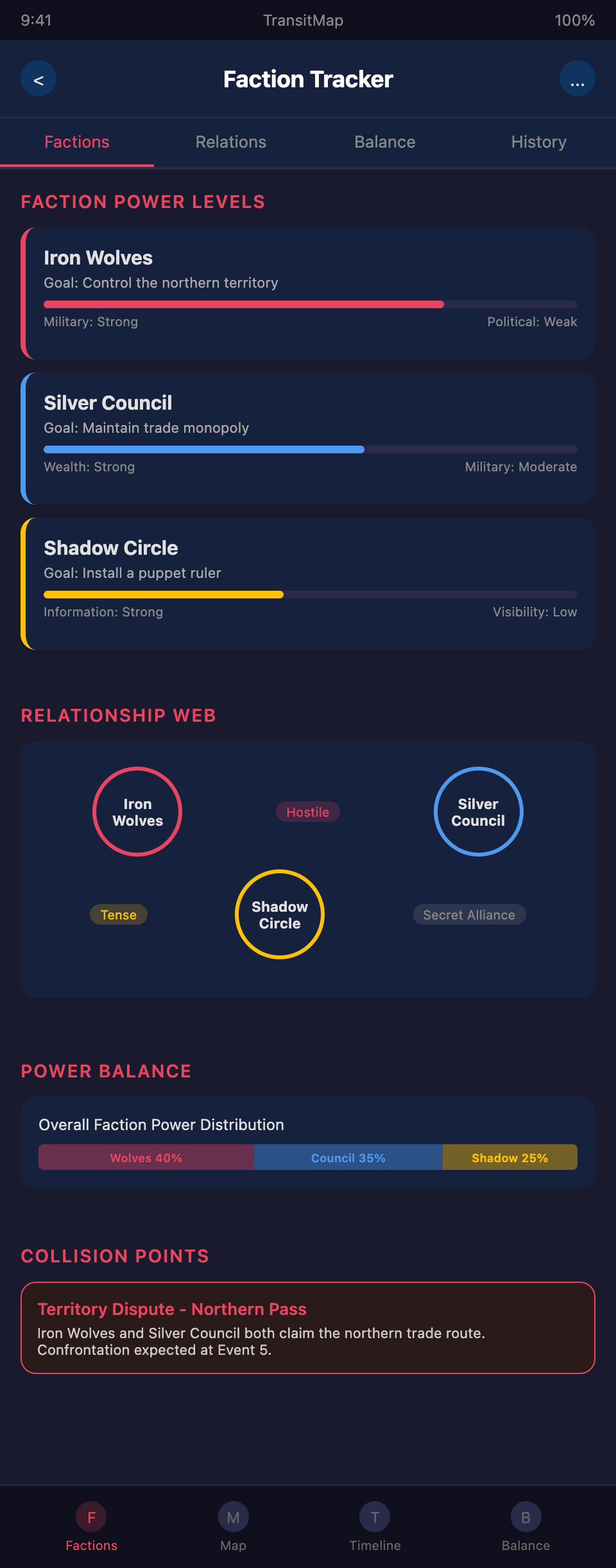
Between events, maintain a faction state document:
- Power level — Resources, territory, allies, and capabilities
- Relationships — Current stance toward each other faction (hostile, tense, neutral, cooperative, allied)
- Leadership — Current faction leaders and their positions on key issues
- Active operations — What each faction is currently doing
- Grievances and debts — What each faction owes or is owed by other factions
This document is your starting point for designing the next event's faction dynamics.
Need to track faction conflicts across events and keep every rivalry balanced and dynamic? Join the TransitMap waitlist — map faction storylines as competing transit routes, with power levels, alliances, and collision points visible at every station.