Post-Event Continuity for LARP Campaigns: What Carries Forward
The Continuity Window
There is a critical window after each LARP event — roughly 48 to 72 hours — during which the organizer team must capture, reconcile, and canonize what happened. After that window, memories fade, details blur, and the opportunity to establish consistent continuity is lost.
This is the post-event continuity process, and it is arguably the most important administrative task in campaign LARP. What you establish as canon after this event becomes the foundation for every future event. Get it wrong, and contradictions will haunt your campaign for years.
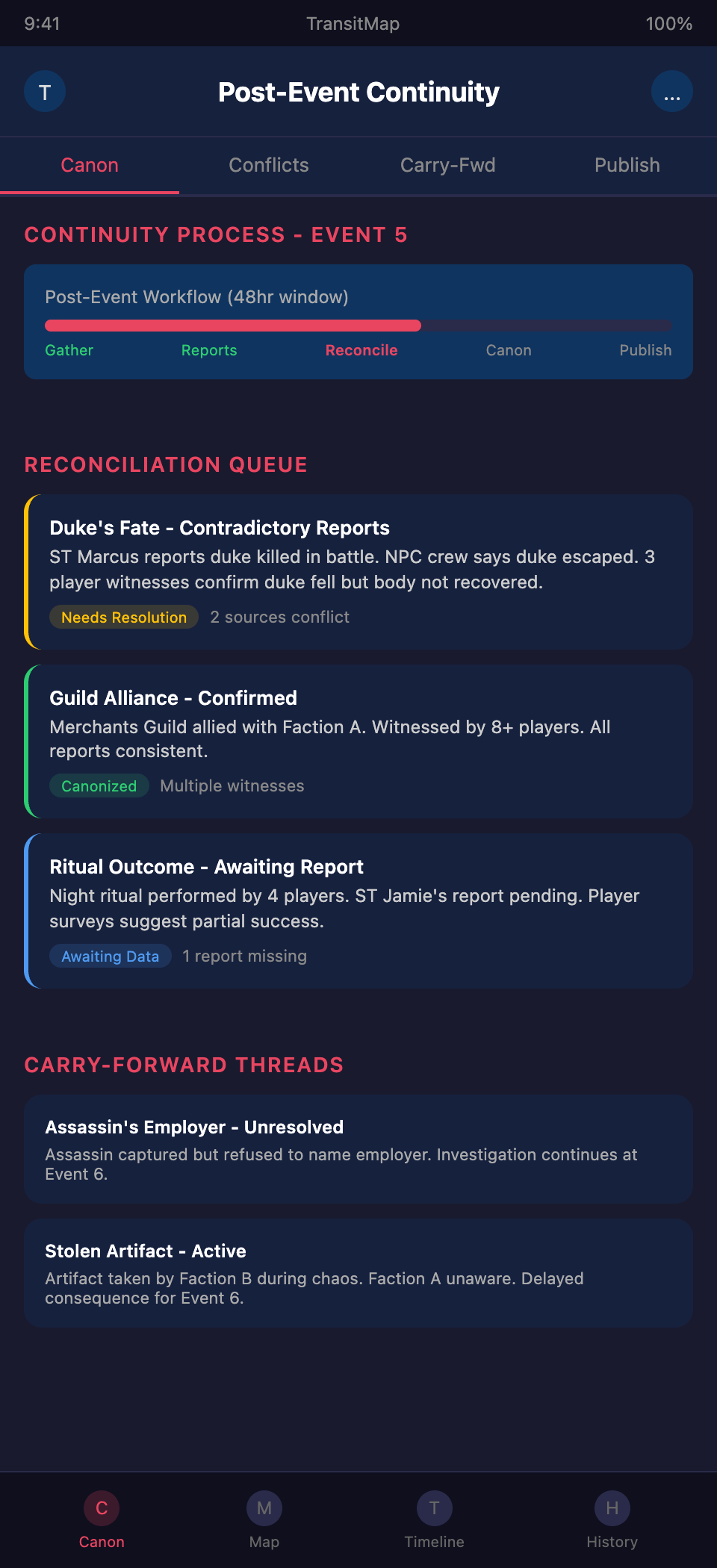
Step 1: Gather Reports (Within 24 Hours)
Collect information from every available source while memories are fresh:
Storyteller reports. Each line storyteller writes a brief report covering:
- What happened in their storyline (planned beats hit, planned beats missed, unplanned events)
- Key NPC actions and fates
- Player choices that significantly affected the storyline
- Continuity-sensitive information that was revealed or established
NPC crew reports. Crew members who played significant NPCs report on their interactions:
- What information did they share with players?
- What information did players share with them?
- What promises or agreements were made?
- Were there any scenes where improvisation led to new canonical facts?
Player feedback. Post-event surveys or informal check-ins gather the player perspective:
- What were the most significant events from the players' point of view?
- What decisions did players make that they expect to have lasting consequences?
- Are there any events that players witnessed differently from each other?
Photographic and video evidence. If available, review any recordings for details about what physically happened during key scenes — who was present, what was said, what physical actions occurred.
Step 2: Reconcile Contradictions (Within 48 Hours)
With reports gathered, the lead storyteller reviews them for contradictions:
Factual contradictions. Different sources disagree about what happened. "The duke was killed during the battle" versus "the duke escaped during the battle." Resolve these by triangulating sources — who was physically present? Whose perspective is most reliable?
Information contradictions. Different NPCs told different players different things about the same topic. Was this intentional (disinformation) or accidental (NPC error)? If intentional, document both versions as canon — different characters have different information. If accidental, decide which version is canon and note the correction.
Timeline contradictions. Events that could not have happened in the order described. The assassination cannot have happened before noon if the assassin was seen at the market until 1 PM. Reconstruct the timeline using physical evidence and multiple accounts.
Resolution principles:
- Physical evidence outweighs verbal claims
- Multiple witnesses outweigh single witnesses
- Intentional actions outweigh accidental ones
- If truly unresolvable, the lead storyteller makes a ruling and it becomes canon
Step 3: Establish Canon (Within 72 Hours)
Once contradictions are resolved, produce the canonical event record — the official account of what happened. This document contains:
The event summary. A narrative overview of the event's major events in chronological order. This should read like a history — factual, comprehensive, and neutral.
Storyline resolutions. For each storyline, document:
- Starting state → ending state
- Key events and their outcomes
- Unresolved threads that carry forward
- New threads that were created
Character status updates. For each significant player character and NPC:
- Current state (alive, dead, injured, transformed, missing)
- Current disposition (toward factions, toward other characters)
- Commitments made (alliances, debts, promises)
- Information acquired (secrets learned, clues found)
World state changes. Any changes to the game world:
- Political changes (new leaders, fallen governments, treaties)
- Geographic changes (destroyed buildings, new constructions, territorial shifts)
- Economic changes (trade route changes, resource discoveries, wealth transfers)
- Magical or supernatural changes (rituals performed, wards broken, curses laid)
Step 4: Communicate Canon to Players (Within 1 Week)
Players need to know what is officially true about their game world. Publish:
The public summary. A version of the event summary that contains only information that is common knowledge in the game world. Shared with all players.
Faction briefings. Faction-specific updates that include information known only to that faction. Shared with faction members only.
Personal updates. Individual messages to players whose characters have specific continuity concerns — secret information, private interactions, or pending consequences. These should confirm what the player experienced and flag any organizer decisions that might differ from the player's perception.
Step 5: Set Up the Next Event's Starting State
The canonical event record becomes the foundation for next event planning:
Carry-forward threads. List every unresolved storyline and its current state. These are your starting points for the next event's content design.
Changed dynamics. Identify how the event changed the game world's dynamics. New alliances, new enmities, new power balances. These inform your next event's faction design.
Player expectations. Based on player feedback and character actions, identify what players are expecting or hoping for at the next event. These expectations should inform your content priorities.
Consequences yet to manifest. Some event outcomes have delayed consequences. The ritual performed will take effect in three game-months. The message sent will arrive at its destination before the next event. The betrayal will be discovered when the evidence surfaces. Note these and schedule their activation.
Common Post-Event Continuity Mistakes
- Skipping the process entirely — Hoping you will remember everything. You will not. Even a brief reconciliation process is better than none.
- Canonizing mistakes — An NPC accidentally revealed information they should not have. Do not canonize the accident — retcon it discreetly and inform affected players.
- Ignoring player-created canon — Players establish facts through roleplay that organizers never planned. A player's character publicly swore an oath. Two characters got married. A faction leader made a speech declaring war. These are canon even if no organizer witnessed them.
- Delayed communication — Publishing the canonical record months after the event. By then, players have formed their own memories and contradictions are entrenched.
- Over-detailing — Writing a 50-page canonical record that nobody reads. Keep it concise. Focus on changes and decisions, not description.
Need a system to manage post-event continuity across your LARP campaign? Join the TransitMap waitlist — track canonical events, carry-forward threads, and world state changes on a visual timeline that grows with every event.