Real-Time Plot Adjustment at LARP Events: Thinking on Your Feet
The Inevitability of Going Off-Script
No LARP plot survives contact with players. This is not a design flaw — it is the nature of live interactive storytelling. Unlike tabletop games where the GM can pause, think, and redirect, LARP events continue in real time. Players are autonomous agents making decisions you cannot predict, forming alliances you did not plan, and finding solutions you never considered.
The organizers who run the best events are not the ones with the best scripts. They are the ones with the best adaptation skills — the ability to recognize when a plot has deviated, assess the deviation's impact, and adjust the storyline in real time without breaking the narrative.
The Three Levels of Plot Deviation
Not all deviations are equal. Categorize them to determine your response:
Level 1: Flavor deviations — The plot is proceeding as planned, but the players are approaching it differently than expected. The negotiation is happening, but the players are using threats instead of diplomacy. The investigation is on track, but they started with the witnesses instead of the crime scene.
Response: Do nothing. Let it play out. The storyline will reach its key beats through a different path. Adjust NPC reactions to match the players' approach.
Level 2: Structural deviations — The plot's sequence has been disrupted. Players skipped a key scene, combined two plotlines unexpectedly, or reached a conclusion before finding all the clues.
Response: Adjust the remaining structure. If they skipped the investigation and went straight to the suspect, the confrontation happens earlier and with less information. If two plotlines merged, the combined scene needs to serve both storylines. Communicate with affected storytellers.
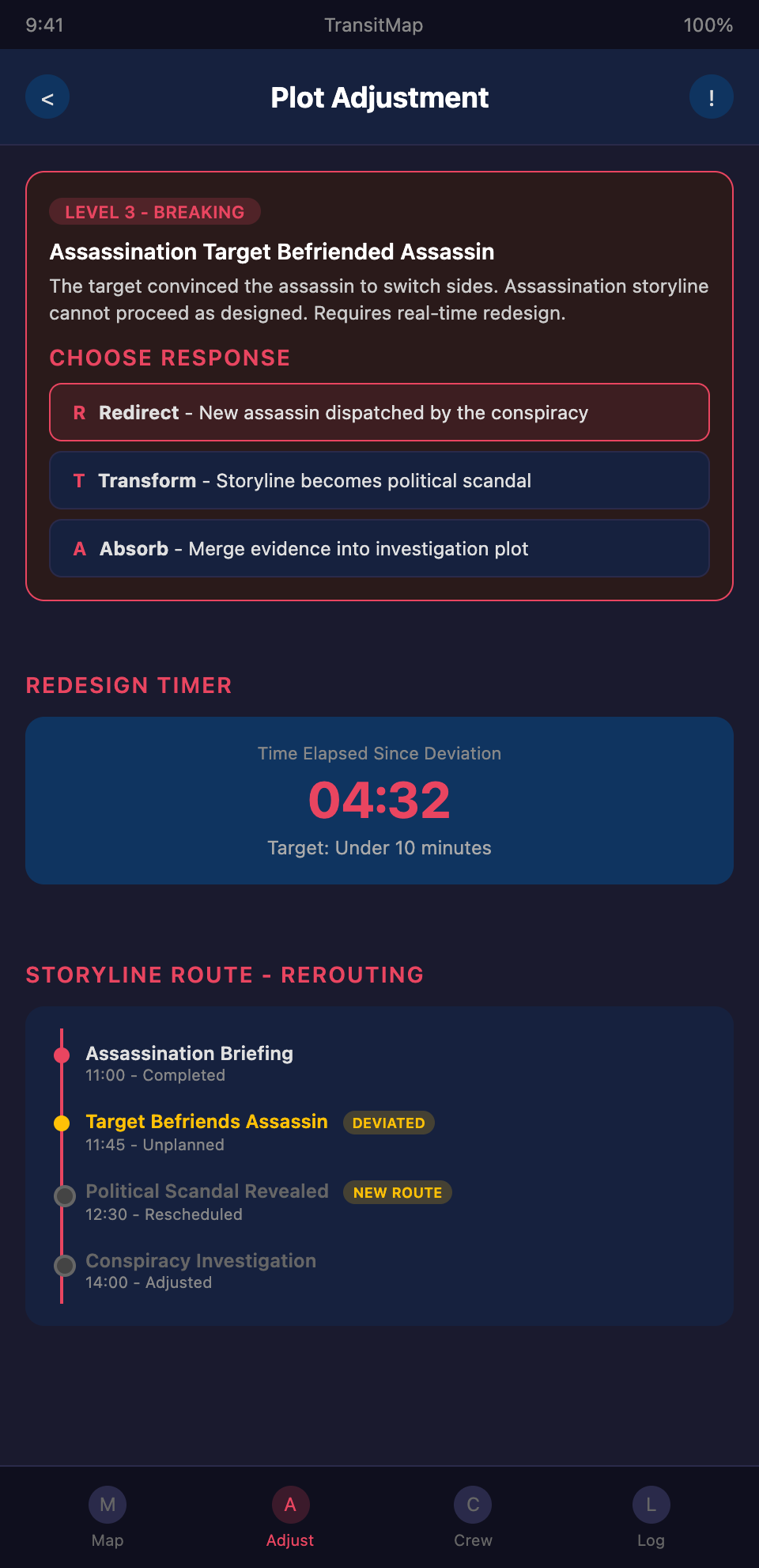
Level 3: Breaking deviations — The plot cannot continue as designed. The assassination target died to a different cause. The macguffin was destroyed. The NPC the players need was killed or driven away. The fundamental premise of the storyline has been invalidated.
Response: Redesign in real time. This is the hardest skill in LARP organization and the one that separates experienced organizers from beginners.
The Real-Time Redesign Process
When a Level 3 deviation occurs, follow this process:
Step 1: Freeze your reaction (30 seconds). Do not immediately try to fix things. Take a breath. Let the scene play out for a moment while you think. Hasty corrections often create bigger problems than the original deviation.
Step 2: Assess the impact (2 minutes). Ask yourself:
- What storyline beats are now impossible?
- What storyline beats are still achievable through a different path?
- What new possibilities has the deviation created?
- Which players are affected?
- Which NPCs need to be redirected?
Step 3: Choose a response (1 minute). You have three options:
-
Redirect: Route the storyline through a new path to the same destination. The target is dead, but the assassin can still be caught. The macguffin is destroyed, but a fragment survived. Different path, same outcome.
-
Transform: Accept the deviation and let the storyline become something new. The assassination failed and the target is now aware of the plot — the storyline transforms from "assassination" to "political crisis." This often creates better drama than the original plan.
-
Absorb: Merge the broken storyline into another active storyline. The assassination plot failed, but the evidence of the conspiracy feeds into the investigation plotline. The broken storyline's content enriches another one.
Step 4: Communicate (2 minutes). Brief your storyteller team on the change. Update affected NPCs. If necessary, redirect crew members to new positions.
Step 5: Execute. Implement the change and monitor results.
The entire process should take under ten minutes. Longer than that, and the event moves on without you.
Building Adaptation Capacity
You can prepare for improvisation:
Design flexible beats, not fixed scenes. Instead of "the assassin attacks during the feast," design "the assassination attempt happens at a moment of social gathering." This gives you multiple windows for the same beat.
Create modular NPCs. An NPC with a flexible backstory can be redirected more easily than one with a rigid script. "A messenger with urgent news" is more flexible than "the duke's personal courier with a sealed letter about the trade agreement."
Prepare contingency hooks. For each major plotline, prepare two or three "what if" scenarios:
- What if the players resolve this plotline early?
- What if the players ignore this plotline entirely?
- What if the players ally with the antagonist instead of opposing them?
You do not need to fully plan these contingencies. A one-sentence note is enough: "If assassination fails, the conspiracy becomes a political scandal."
Empower your NPCs. Brief your crew members to improvise within their character's boundaries. An NPC who can make decisions based on their character's motivations is more valuable than one who can only follow a script. Give NPCs clear motivations and let them react authentically.
Common Adjustment Mistakes
Over-correcting. A minor deviation leads to a major restructuring that disrupts the rest of the event. Match your response to the severity of the deviation.
Undermining player choices. The players killed the villain in Act 1? Do not have the villain magically survive. Let the villain die and adjust the remaining plot. Players who feel their actions are being undone will stop trying.
Invisible adjustments. You make a brilliant real-time adjustment, but the affected players do not understand what happened. If a storyline changes direction, make the change visible in-game. An NPC announces new information. A consequence occurs that explains the shift.
Adjusting without communicating. You redirect a storyline but do not tell the line storyteller responsible for it. They continue running the old version while you are running the new one. Contradictions and confusion result.
Paralysis. You cannot decide how to respond, so you do nothing and the event grinds to a halt in the affected area. A fast imperfect decision is better than a slow perfect one. Decide, execute, adjust if needed.
Training Your Team for Real-Time Adjustment
Your storyteller team should practice adaptation before the event:
- Run tabletop simulations. Walk through key plotlines as a group, with team members playing player roles and deliberately deviating. Practice the assessment-and-response cycle.
- Establish authority levels. Who can make adjustment decisions? Line storytellers should be authorized to handle Level 1 and Level 2 deviations independently. Level 3 deviations should involve the lead storyteller.
- Create a shared vocabulary. "Redirect," "transform," and "absorb" as defined responses give your team a common language for discussing adjustments quickly during the event.
Want a coordination system that helps you adjust LARP plots in real time? Join the TransitMap waitlist — see all your storylines as live transit routes, spot deviations instantly, and reroute narratives with the clarity of a transit operations dashboard.