Tracking Player Character Arcs Across LARP Campaigns
Why Character Arc Tracking Matters in LARP
In tabletop RPGs, the GM sees every player's character development in real time. In LARP, character development happens across multiple events, in scenes the organizer may never witness, through interactions the organizer may never know about. A player's character might undergo a profound transformation at 2 AM around a campfire — and the organizer only learns about it when the player mentions it weeks later.
This invisibility creates a problem: if the organizer does not know how a character has changed, they cannot design content that responds to that change. The player who went through a crisis of faith gets the same generic quest hooks as the player whose character is exactly where they started. The result is a campaign that feels impersonal despite being live and immersive.
Tracking character arcs across events transforms your LARP campaign from a series of disconnected adventures into a continuous narrative that recognizes and rewards player investment.
What to Track Per Character
You do not need a novel's worth of information for each character. Track five elements:
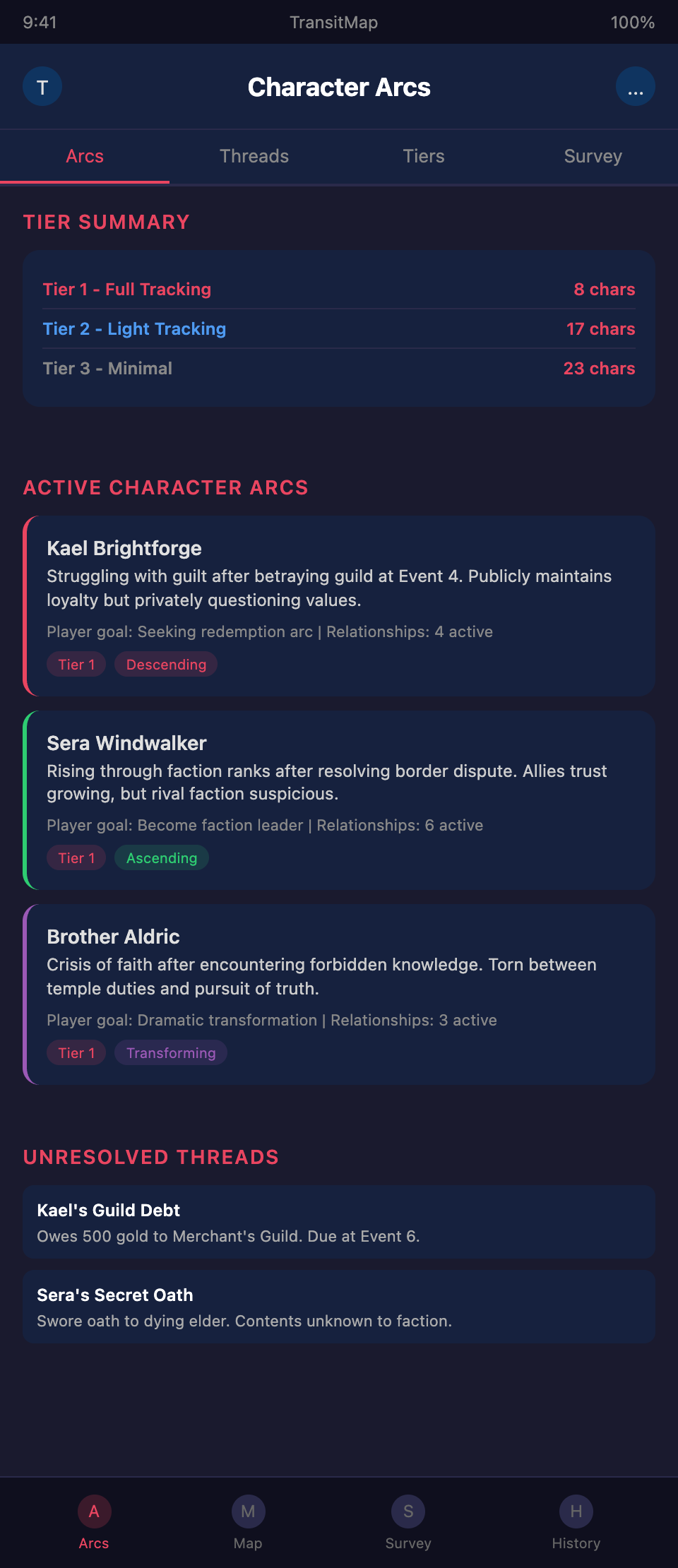
Current state — Where is this character emotionally and narratively right now? One or two sentences. "Struggling with guilt after betraying their guild at the last event. Publicly maintains loyalty but privately questioning their values."
Key relationships — Which other characters (player and NPC) matter most to this character? How have those relationships changed since the last event?
Unresolved threads — What is this character actively dealing with? Debts owed, promises made, quests in progress, secrets being kept.
Player goals — What does the player (not the character) want for their character? Are they seeking redemption? Looking for a dramatic death? Hoping to become faction leader? These are distinct from character goals and inform how you design content for them.
Arc trajectory — Where is this character's story going? Is it ascending (building toward triumph), descending (heading toward tragedy), or transforming (becoming something fundamentally different)?
Gathering Character Information
The challenge is obtaining this information without being physically present for every scene. Multiple input channels help:
Post-event surveys. Send every player a brief survey after each event:
- What was your character's most significant moment this event?
- How has your character changed since the last event?
- What does your character want to do at the next event?
- Is there anything you want the organizers to know about your character's story?
Keep the survey short — five questions maximum. Long surveys get ignored. Even three questions is better than none.
Pre-event check-ins. Before each event, reach out to returning players: "Last event, your character was dealing with [X]. Is that still where your character is? Has anything changed between events?"
In-event observation. Assign a storyteller or a trusted crew member to observe key scenes and report on character developments. They do not need to record everything — just notable character moments and relationship changes.
Player-submitted journals. Invite players to write between-event journal entries or character updates. Reward this with small in-game benefits (a rumor, a minor item, a narrative advantage) to encourage participation.
Debriefs with line storytellers. After each event, each line storyteller reports on character developments they observed within their storyline.
Building Content Around Character Arcs
Once you have character arc data, use it to design personalized content:
Arc-responsive hooks. Instead of generic quest hooks ("there's a monster in the woods"), create hooks that respond to specific characters' arcs. The character struggling with guilt gets a chance at redemption. The character seeking power gets an opportunity with strings attached. The character questioning their faith encounters evidence that challenges or confirms their beliefs.
Relationship catalysts. When you know which character relationships are most significant, you can create situations that test those relationships. The two characters who are developing a romance face a situation where their factions are in conflict. The mentor-student pair face a challenge where the student must surpass the mentor.
Arc mirrors. Create NPC storylines that mirror player character arcs. The player character dealing with betrayal meets an NPC who was betrayed and chose a different path. This gives the player a narrative reference point for their own character's journey.
Climactic moments. When a character arc is approaching a climax — a critical decision, a confrontation, a transformation — design a scene specifically for that moment. Coordinate with the player to ensure it happens at the right time and with the right people present.
Managing Arc Tracking at Scale
For a campaign with forty or more active characters, individual tracking becomes labor-intensive. Scale management strategies:
Tier your tracking. Not every character needs deep tracking:
- Tier 1 (full tracking) — Characters with active, complex arcs that drive storylines. Usually 8-12 characters. Full five-element tracking with regular updates.
- Tier 2 (light tracking) — Characters with developing arcs that are not yet central to storylines. Usually 15-20 characters. Track current state and unresolved threads only.
- Tier 3 (minimal tracking) — Characters with stable states and no active development. Track name, faction, and basic disposition only.
Promote and demote regularly. When a Tier 3 character begins an interesting arc, promote them. When a Tier 1 character's arc resolves, demote them.
Delegate to faction leads. If your LARP has player faction leaders, ask them to report on character developments within their faction. They are closer to the daily interactions and will notice changes you miss.
Use a standardized format. Whatever tracking system you use, keep the format consistent. One page per character, same fields, same structure. When you need to find information quickly before or during an event, consistency saves time.
Common Character Arc Tracking Mistakes
- Tracking backstory instead of development — A character's backstory does not change. Their arc does. Focus on what is happening now and what is changing, not on what happened before the campaign started.
- Ignoring player intent — A player whose character is heading toward a tragic fall does not want you to rescue them with a redemption arc. Ask what the player wants and design accordingly.
- Treating characters as static — Updating a character's entry once and never revisiting it. Characters change every event. If your records are three events old, they are unreliable.
- Over-orchestrating arcs — Designing every beat of a character's arc removes the player's agency. Design situations and opportunities, not outcomes. Let the player decide how their character responds.
Want to track every player character's arc across your LARP campaign? Join the TransitMap waitlist — map character journeys as individual transit lines that evolve event by event, with key moments, relationships, and turning points all visible.