Designing Faction Systems for RPG Modules
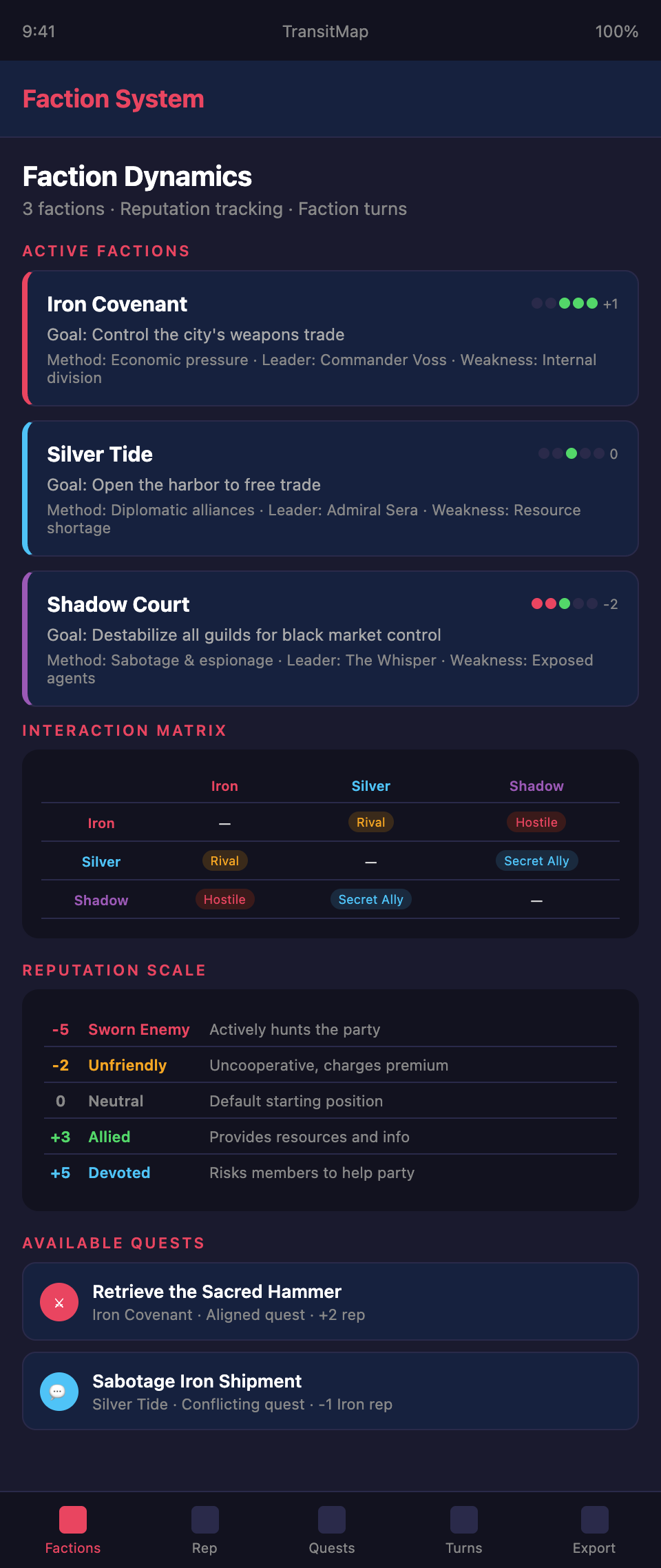
Why Factions Matter for Module Design
A module without factions is a stage set. The scenery is beautiful, but nothing moves unless the players push it. A module with factions is a machine. The parts move on their own, creating situations the players must respond to.
Factions provide three things that individual NPCs cannot:
Persistence. An NPC can be killed, avoided, or forgotten. A faction persists. Remove one member and another takes their place. Factions create lasting relationships with the party.
Scale. An NPC can threaten a room. A faction can threaten a city. Factions raise stakes beyond the personal to the political and societal.
Reactivity. An NPC reacts based on personal motivation. A faction reacts based on organizational goals, resources, and doctrine. Faction reactions feel systemic rather than personal, which makes the world feel larger.
Faction Design Template
Design each faction with these elements:
Name and identity. A memorable name, a visual symbol, and a core identity that the GM and players can grasp immediately. "The Iron Covenant — a militant order of smiths who believe weapons are sacred."
Goal. What the faction wants. This should be specific and achievable: "Control the city's weapons trade" is better than "gain power." Goals create action.
Method. How the faction pursues its goal. Methods define the faction's personality: "Through economic pressure and strategic alliances" versus "through intimidation and sabotage." The same goal pursued through different methods creates different encounters.
Resources. What the faction has access to — people, money, locations, information, magical capabilities, political connections. Resources define what the faction can do in response to player actions.
Leader. A named NPC who embodies the faction's values and makes decisions on its behalf. The leader is the faction's face — the person the players interact with when they deal with the faction.
Weakness. Every faction should have a vulnerability — internal division, resource shortage, a secret that could be exploited, a leader with a blind spot. Weaknesses give the players tools to affect the faction.
Relationship to other factions. Each faction should have a defined relationship with every other faction in the module: allied, rival, neutral, or hostile.
The Faction Interaction Matrix
Map faction relationships in a matrix:
| Iron Covenant | Silver Tide | Shadow Court | |
|---|---|---|---|
| Iron Covenant | — | Rival | Hostile |
| Silver Tide | Rival | — | Secret Alliance |
| Shadow Court | Hostile | Secret Alliance | — |
This matrix shows the GM the political landscape at a glance and predicts how faction dynamics will shift when the players affect one faction.
Faction Reputation System
Track the party's standing with each faction using a simple reputation system:
Scale: -5 to +5
| Score | Attitude | Behavior |
|---|---|---|
| -5 | Sworn enemy | Actively hunts the party |
| -3 to -4 | Hostile | Refuses cooperation, may attack |
| -1 to -2 | Unfriendly | Uncooperative, charges premium |
| 0 | Neutral | Default starting position |
| +1 to +2 | Friendly | Cooperative, offers fair deals |
| +3 to +4 | Allied | Provides resources and information |
| +5 | Devoted | Risks members to help the party |
Reputation triggers. Define specific actions that change reputation:
- Completing a faction quest: +1 to +2
- Opposing a faction's goal: -1 to -2
- Killing a faction member: -2 to -3
- Helping a rival faction: -1
- Saving a faction leader: +3
Faction Response Protocols
Define how each faction responds to player actions at different reputation levels:
At hostile (-3 to -5):
- Refuses all interaction
- Sends agents to obstruct or attack the party
- Provides information to the party's enemies
- Blocks access to faction-controlled resources and locations
At neutral (-2 to +2):
- Engages in transactional relationships
- Offers quests with appropriate rewards
- Shares non-sensitive information
- Maintains territorial boundaries
At allied (+3 to +5):
- Provides resources, safe houses, and intelligence
- Sends agents to assist in the party's missions
- Shares sensitive information and faction secrets
- Involves the party in faction leadership decisions
Faction Dynamics During Play
Factions should not be static. They should respond to events:
Faction turns. Between game sessions or at defined intervals, each faction takes an action toward its goal. Document these actions in a faction turn sequence that the GM resolves. This keeps factions active even when the players are not interacting with them directly.
Escalation triggers. Define events that escalate faction conflicts. When two rival factions both lose reputation with the party, they may unite against a common threat. When one faction grows too powerful, others may form a coalition.
Collapse conditions. Define what causes a faction to collapse or transform. Loss of their leader, loss of resources, or defeat of their primary goal might dissolve the faction or transform it into something new.
Faction Quests
Each faction should offer quests that advance their goals:
Aligned quests. Tasks that serve the faction's goal and also benefit the party. These are easy hooks: "We need someone to retrieve the artifact from the ruins. We will pay handsomely."
Conflicting quests. Tasks that serve the faction but conflict with another faction's interests or the party's ethics. These create interesting decisions: "We need you to sabotage the rival's shipment. They are good people, but their success threatens our survival."
Faction chain quests. A series of quests that deepen the party's involvement with a faction, revealing more about the faction's true nature and goals with each completed task.
Designing a faction system for your module? Join the TransitMap waitlist — map every faction as a transit line with influence zones, reputation tracking, and interaction dynamics all visible on your adventure's network map.