Designing GM-Friendly Module Layouts
The GM's Reading Context
A GM reads your module in two very different contexts, and your layout must serve both:
Prep reading. Before the session, the GM reads through the module to understand the adventure's structure, characters, and events. During prep reading, the GM needs narrative flow — a clear, engaging presentation that helps them internalize the adventure.
Table reading. During the session, the GM references the module while managing players, narrating scenes, and making rulings. During table reading, the GM needs instant access — the ability to find a specific piece of information in seconds without losing the flow of the game.
Most modules are written for prep reading and fail at table reading. The GM understands the adventure during prep but cannot find the merchant's name, the room description, or the DC for the skill check when they need it at the table.
Information Architecture for Modules
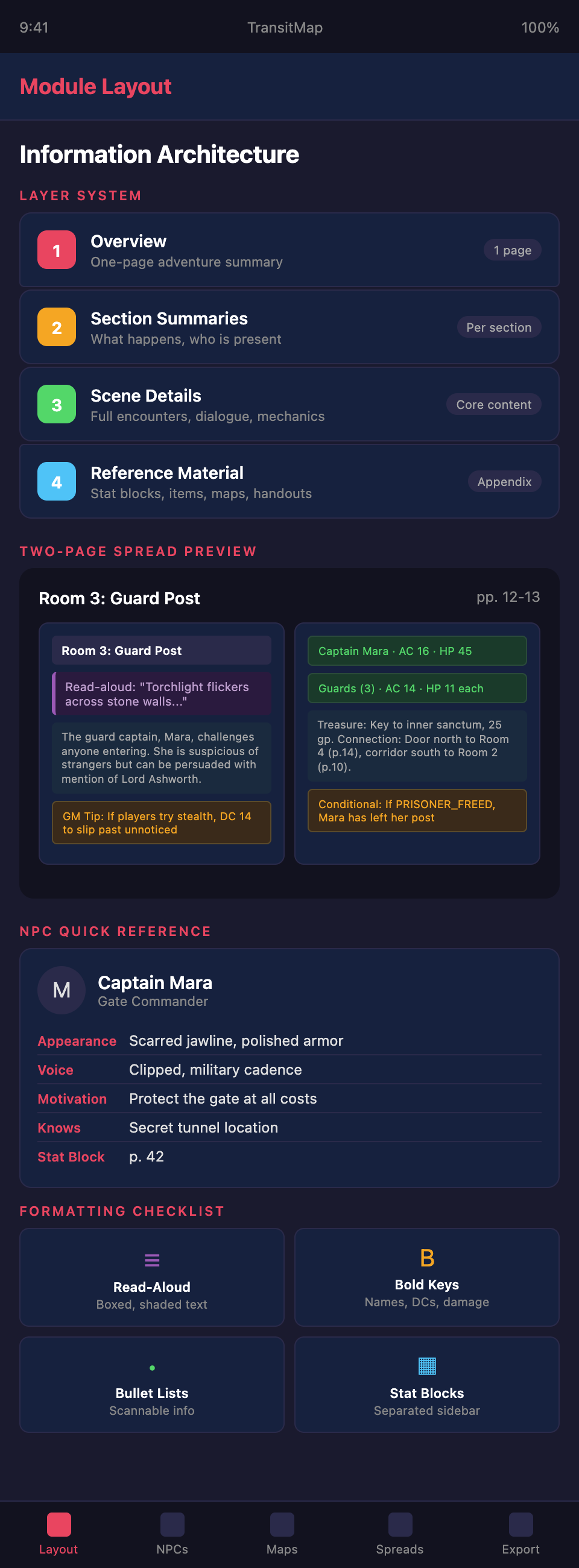
Organize your module's information in layers:
Layer 1: Overview. A one-page summary of the entire adventure. The premise, the major beats, the key NPCs, and the expected flow. This orients the GM during initial prep and serves as a quick reference during play.
Layer 2: Section summaries. Each major section (act, chapter, location area) opens with a brief summary: what happens here, who is present, what the players are likely to do. This helps the GM orient during prep and re-orient during table reading.
Layer 3: Scene details. The full content of each scene, encounter, or location. This is where your descriptive writing, dialogue, and mechanical details live.
Layer 4: Reference material. NPC stat blocks, item descriptions, maps, and handouts. These should be accessible independently from the scene text — a GM should not need to read through a scene description to find a stat block.
Formatting for Table Use
Specific formatting choices dramatically improve table usability:
Boxed read-aloud text. Descriptive text that the GM reads or paraphrases to players should be visually distinct — boxed, shaded, or formatted in italics. The GM needs to identify read-aloud text instantly.
Bold key information. Names, DCs, damage values, and critical story information should be bolded within the body text. When the GM scans a paragraph during play, bolded elements pop out.
Bullet points for lists. When presenting multiple pieces of information (items in a room, NPC knowledge, available options), use bullet points rather than prose paragraphs. Bullet points are scannable; paragraphs are not.
Stat blocks separated from narrative. Do not embed stat blocks in the middle of narrative text. Place them in sidebars, at the end of sections, or in an appendix. The GM needs the stat block at a different moment than they need the narrative.
Consistent headers. Use a clear header hierarchy that the GM can use to navigate the module. Location name, then room number, then encounter type. Consistency lets the GM predict where to find information.
The Two-Page Spread Principle
Design each major scene or location to fit on a two-page spread — the two pages visible when the module is open. The GM should never need to flip pages during an active scene.
What fits on a spread:
- Room or scene description (including read-aloud text)
- Key NPC information for characters present
- Mechanical details (DCs, damage, conditions)
- Treasure or rewards
- Connections to adjacent scenes or rooms
What goes elsewhere:
- Full stat blocks (appendix, unless the creature is unique to this scene)
- Extended lore or backstory (sidebar or separate section)
- Player handouts (appendix)
- Maps (separate page or pull-out)
Sidebar Design
Sidebars are powerful layout tools for module design:
GM advice sidebars. Tips for running a specific scene, handling likely player actions, or adjusting difficulty. These help less experienced GMs without cluttering the main text.
Lore sidebars. Background information that enriches the GM's understanding but is not required during play. History, cultural context, designer's notes.
Conditional sidebars. Information that only applies under specific conditions: "If the players allied with the merchant guild..." These are especially important in branching adventures.
Quick reference sidebars. Summaries of complex rules interactions, NPC relationship charts, or timeline references that the GM might need during play.
NPC Presentation
NPCs are the information GMs most frequently search for during play:
NPC stat card format:
- Name and title or role
- Appearance in one sentence
- Voice cue (accent, speech pattern, key phrase)
- Motivation in one sentence
- What they know as a bullet list
- What they want from the PCs in one sentence
- Stat block reference (page number or appendix reference)
This format gives the GM everything needed to portray the NPC in seconds.
Map Integration
Maps should be functional, not just decorative:
Key maps to the text. Every numbered location on the map should correspond to a numbered section in the text. The GM should be able to look at the map, find a number, and immediately locate the corresponding text.
Include GM maps and player maps. GM maps show secret doors, traps, and hidden areas. Player maps show only what the characters can see. Providing both saves the GM preparation time.
Scale and orientation. Include a scale bar and compass rose on every map. The GM needs to answer "how far is it?" and "which direction?" during play.
Designing a module and want GMs to actually enjoy running it? Join the TransitMap waitlist — map your module's information architecture as a navigable transit system, with scenes, NPCs, and encounters all connected and accessible at a glance.