Managing Conditional Triggers in RPG Module Design
What Are Conditional Triggers?
A conditional trigger is any point in your module where the content changes based on something the players did earlier. The simplest form is a binary condition: if X happened, then A; otherwise, B. More complex conditions involve multiple variables, combinations of past actions, or graduated outcomes based on degree of success.
Conditional triggers are what make non-linear modules feel responsive. When a player's earlier decision visibly affects a later scene, the adventure feels alive — their choices mattered. Without conditional triggers, branching paths are just different routes to the same destination.
Types of Conditional Triggers
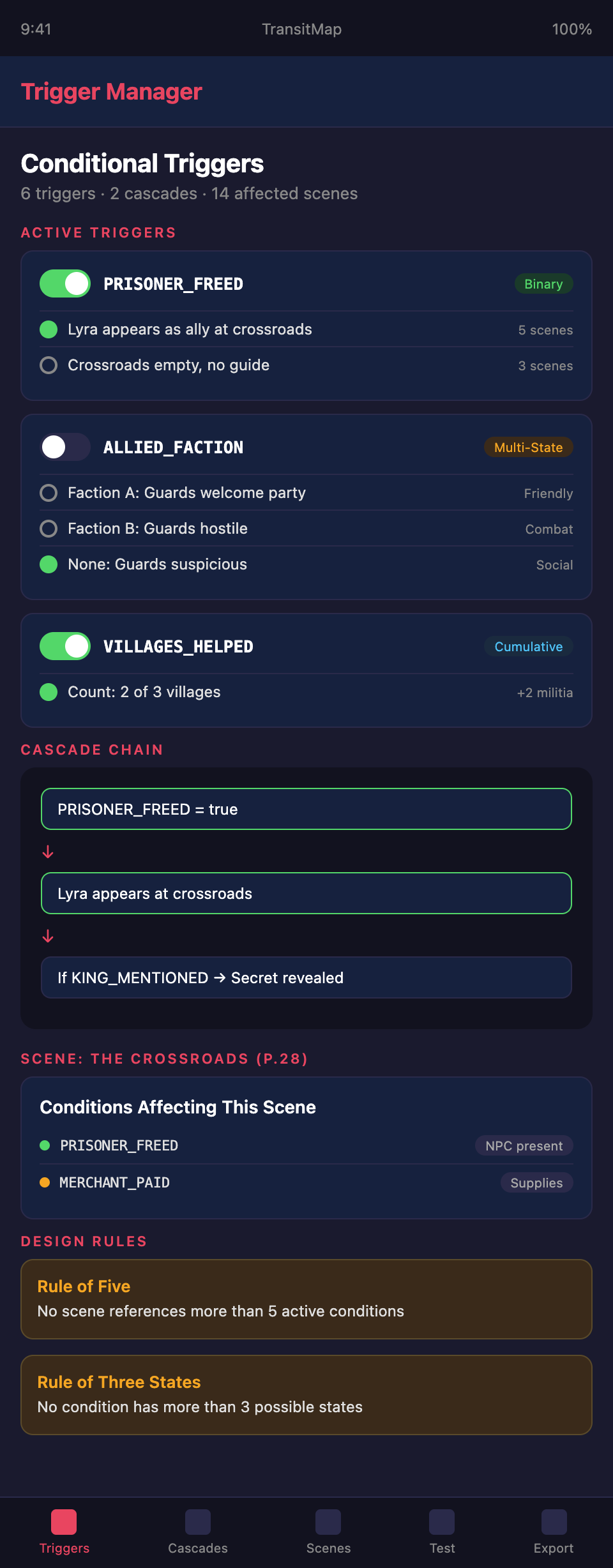
Binary triggers. The simplest type. A single yes/no condition changes the content. "If the players have the key, the door opens. If not, they must find another way in."
Multi-state triggers. A condition with more than two states. "If the players allied with Faction A, the guards welcome them. If they allied with Faction B, the guards are hostile. If they have not allied with either, the guards are suspicious."
Cumulative triggers. The outcome depends on the accumulation of multiple smaller actions. "For each village the players helped, one additional militia unit joins the final battle." These create graduated outcomes rather than binary switches.
Timed triggers. Conditions based on when something happens rather than whether it happens. "If the players reach the tower before sunset, the ritual has not yet begun. If they arrive after sunset, the ritual is in progress."
Cascading triggers. When one conditional trigger activates another. "If the prisoner was freed (Trigger A), she appears in this scene. If she appears and the players mention the king's name, she reveals a secret (Trigger B, dependent on Trigger A)."
Tracking Conditional State
The GM needs a clear system for tracking which conditions are active:
The condition checklist. Provide a dedicated checklist at the front of the module — a list of every conditional trigger with a checkbox. The GM checks or marks each condition as it is activated during play.
Naming conventions. Give every condition a clear, unique name: "PRISONER_FREED," "ALLIED_FACTION_A," "TOWER_BEFORE_SUNSET." Reference these names consistently throughout the text.
Condition summary per scene. At the start of each scene that contains conditional content, list which conditions affect it: "This scene is modified by: PRISONER_FREED, MERCHANT_PAID."
Default states. Every condition should have a clear default. If the GM is unsure whether a condition was triggered, the default state provides a fallback.
Writing Conditional Content
Present conditional content clearly in the text:
If-then formatting. Use a consistent visual format for conditional content:
If PRISONER_FREED: Lyra is standing at the crossroads, waving the party down. She offers to guide them through the marshes. See her stat block on page 42.
If NOT PRISONER_FREED: The crossroads are empty. The marsh path is unmarked and the party must navigate without guidance.
Separate blocks, not inline conditions. Do not embed conditions in the middle of paragraphs. A GM scanning a paragraph will miss an inline condition. Use separate, visually distinct blocks for each conditional variation.
Minimize nested conditions. Avoid conditions within conditions whenever possible. "If A, then if B, then if C..." quickly becomes unreadable. Flatten nested conditions into a simple lookup: "If A and B and C: [content]."
Limiting Conditional Complexity
Every condition you add multiplies the GM's cognitive load:
The rule of five. No single scene should reference more than five active conditions. Beyond five, the GM cannot practically manage the state tracking while also narrating, managing players, and running mechanics.
The rule of three states. No single condition should have more than three possible states. More than three states means the GM is effectively running a different adventure for each state combination.
Consolidate related conditions. If several conditions all relate to the same narrative question, consolidate them into a single multi-state condition. Instead of tracking HELPED_VILLAGE_1, HELPED_VILLAGE_2, HELPED_VILLAGE_3 separately, track VILLAGES_HELPED with a count.
Scope conditions locally. A condition triggered in Chapter 1 that affects Chapter 5 is harder to track than a condition triggered in Scene A that affects Scene B. Keep conditions as local as possible.
Testing Conditional Triggers
The matrix test. For each scene with conditional content, create a matrix of all possible condition states and verify that the scene works for each combination.
The forgetful GM test. What happens if the GM forgets to track a condition? If a missed condition creates a plot hole or dead end, the condition needs either a safety net (the scene works either way) or a more prominent tracking mechanism.
The cascade test. For cascading triggers, trace each cascade path from start to finish. Verify that every trigger in the chain can actually be activated and that no cascade leads to a contradiction.
The edge case test. What happens if the players partially trigger a condition? What if they freed the prisoner but the prisoner died later? Design conditions to handle partial or edge-case states.
Managing conditional triggers across a complex module? Join the TransitMap waitlist — track every condition as a switch on your adventure's transit map, with cascading effects and state combinations visible at every node.