RPG Adventure Path Pacing: A Designer's Guide
Pacing as a Design Discipline
Pacing in an RPG module is not about controlling how fast the players move through content. It is about designing the content so that the experience has rhythm — tension and release, action and reflection, intensity and calm. When pacing works, the players finish each session wanting more. When it fails, they finish mid-session wanting less.
Module designers often focus on content quality and neglect pacing structure. They write excellent encounters, interesting NPCs, and compelling mysteries — then arrange them in a sequence that exhausts players with back-to-back intensity or bores them with extended lulls.
The Pacing Curve
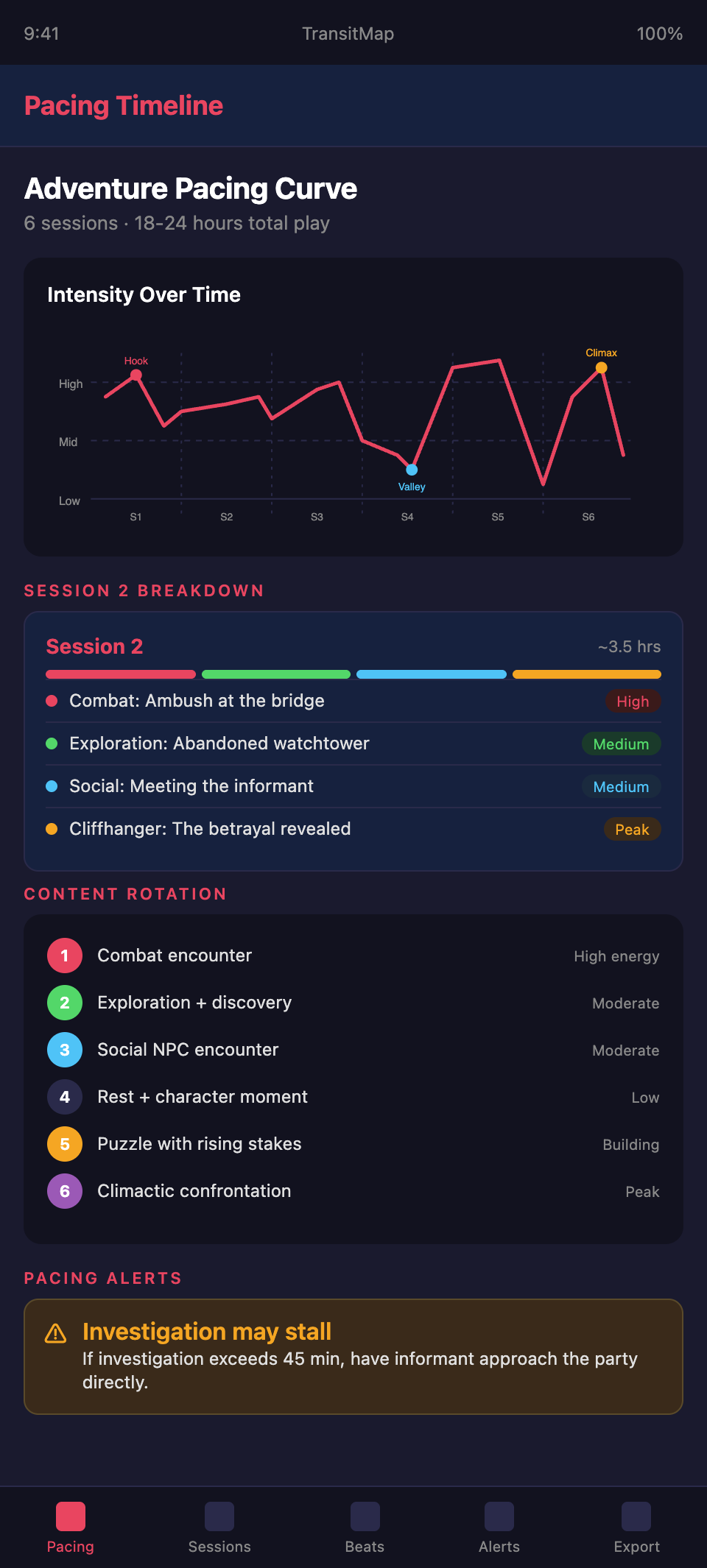
Every adventure should follow a pacing curve — a deliberate pattern of rising and falling intensity:
The opening hook (high intensity). The adventure begins with an engaging situation that demands immediate attention. A combat ambush, a desperate plea, a shocking discovery. This hooks the players and establishes the adventure's energy.
Establishment (moderate intensity). After the hook, settle into the adventure's premise. Introduce the location, the NPCs, the situation. Give players time to explore and ask questions. This phase builds the foundation for later intensity.
Development (rising intensity). The core of the adventure. Encounters escalate in difficulty and stakes. New complications arise. The mystery deepens. Each encounter should be slightly more intense than the last.
The valley (low intensity). A deliberate lull before the climax. A rest opportunity, a character moment, a calm scene that contrasts with what is coming. This valley makes the climax hit harder by providing contrast.
Climax (peak intensity). The adventure's highest-stakes encounter. This should be the most challenging, dramatic, and consequential content in the module.
Resolution (declining intensity). The aftermath. Consequences are revealed, rewards are distributed, the world reacts to the players' actions. The adventure closes with a sense of completion.
Session-Level Pacing
Design your adventure with session boundaries in mind:
Estimate session length. A typical session runs three to four hours. Design content blocks that fit within that window, with natural stopping points at session boundaries.
Session structure. Each session within the adventure should have its own mini-arc:
- Session opening: Re-establish context and present the session's immediate goal
- Session development: Two to three encounters or scenes
- Session closing: A cliffhanger, revelation, or satisfying beat that ends the session on a strong note
Pacing landmarks. Mark points in the adventure where a session break naturally falls. Note these for the GM: "This is a natural stopping point for a session break."
Avoid mid-encounter breaks. Design encounters to resolve within a session. A combat encounter that spans two sessions loses momentum and requires extensive recapping.
Content Type Rotation
Vary the type of content to maintain engagement:
Combat encounters are high-energy but draining. Back-to-back combat exhausts players mentally and depletes character resources.
Social encounters are engaging but require sustained focus. Extended social scenes without breaks for action can lose player attention.
Exploration is stimulating but can stall without direction. Exploration needs objectives to maintain momentum.
Puzzle encounters are satisfying but frustrating when they stall. Include fallback solutions for puzzles that might take too long.
A pacing rotation example:
- Combat encounter (high energy)
- Exploration with discovery (moderate energy, reward)
- Social encounter with NPC (moderate energy, information)
- Rest and character moment (low energy, recovery)
- Puzzle with rising stakes (building energy)
- Climactic combat or confrontation (peak energy)
Pacing for Different Group Types
Different tables pace differently. Design your module to accommodate variation:
Fast groups. Some tables move through content quickly — they make decisions rapidly, resolve combat efficiently, and do not linger on roleplay. For these groups, your adventure may run short. Include optional content that expands the adventure without affecting the core experience.
Slow groups. Some tables take their time — extended roleplay, cautious exploration, thorough investigation. For these groups, your adventure may run long. Include guidance on which content can be condensed or skipped without damaging the narrative.
Mixed groups. Most tables are mixed — fast in combat, slow in roleplay, or vice versa. Mark sections where pacing typically varies and include adjustment notes.
Pacing Indicators in the Text
Help the GM manage pacing with explicit indicators:
Estimated time. Note expected play time for each major section: "This dungeon level typically takes 60-90 minutes to explore."
Pacing warnings. Flag potential pacing issues: "If the investigation phase extends beyond 45 minutes, consider having the informant approach the party directly."
Acceleration options. When the adventure might stall, provide options to accelerate: "If the party has not found the hidden passage after exploring three rooms, a minor earthquake reveals it."
Deceleration options. When the adventure might rush, provide options to slow down: "If the party reaches the tower ahead of schedule, the bridge is out and they must find an alternative crossing."
Designing an adventure with deliberate pacing? Join the TransitMap waitlist — map your adventure's pacing curve as a visual transit line, with intensity markers, session break points, and content type indicators all visible on one timeline.