Building Effective Cross-Reference Systems for RPG Modules
The Navigation Problem
RPG modules are not novels. They are not read front to back and never revisited. They are reference documents consulted repeatedly, out of order, under time pressure, while the GM simultaneously manages a table of players. Every second the GM spends searching for information is a second the game stalls.
Complex modules — especially non-linear ones — compound this problem. An NPC might appear in three different chapters depending on player choices. An item introduced in one location might be relevant in five others. A faction's motivations might be explained in their introduction but relevant during encounters throughout the adventure.
A cross-reference system makes these connections navigable.
Elements That Need Cross-Referencing
NPCs. Every named NPC should reference:
- The page where they are first introduced with full details
- Every scene where they appear or are mentioned
- Related NPCs (allies, rivals, family, faction members)
- Relevant items they carry, guard, or know about
Locations. Every named location should reference:
- Connected locations (physically adjacent or narratively linked)
- NPCs present at or associated with the location
- Items found at the location
- Events that occur at the location on different paths
Items. Every significant item should reference:
- Where the item can be found
- NPCs who know about, want, or guard the item
- Scenes where the item is relevant
- Mechanical effects and any page references for rules
Factions. Every faction should reference:
- All faction NPCs and their roles
- Faction-controlled locations
- Scenes where faction goals are relevant
- How faction relationships change based on player choices
Plot threads. Every major plot thread should reference:
- The scene where it is introduced
- All scenes that develop, complicate, or resolve it
- NPCs involved in the thread
- Conditions that affect the thread's development
Cross-Reference Formats
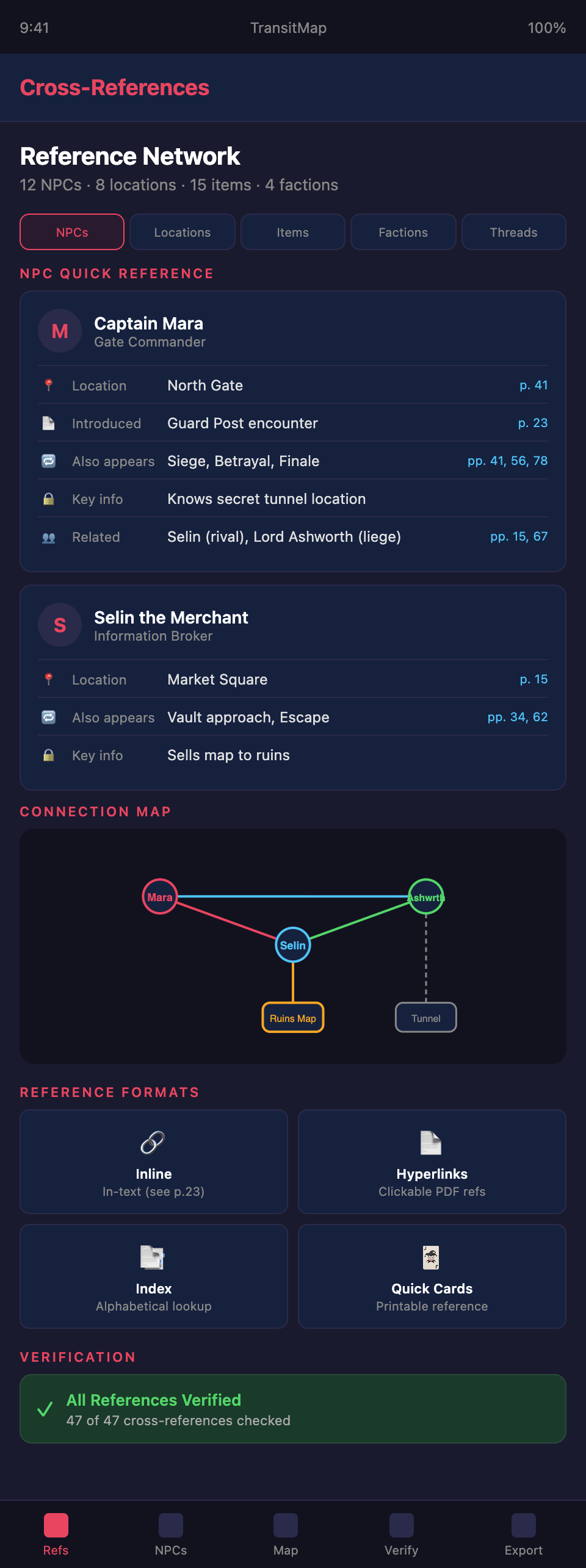
Inline references. References embedded in the text: "Captain Mara (see page 23) is stationed at the North Gate (see page 41)." Simple and direct, but they clutter the text if overused.
Margin references. References placed in the margin alongside the relevant text. These keep the main text clean while providing navigation. Effective in print but may not translate to digital formats.
Hyperlinked references. In digital modules (PDFs, VTT platforms), hyperlinked text that jumps directly to the referenced content. The most user-friendly format for digital modules.
Index references. A comprehensive index at the back of the module, organized alphabetically by NPC, location, item, and faction. Useful as a master reference but slow to consult during play.
Quick-reference cards. Separate reference sheets or cards that summarize key information with page references. These can be printed and placed in front of the GM during play.
Building the Cross-Reference System
Step 1: Inventory. List every named NPC, location, item, faction, and plot thread in your module. This is your reference universe.
Step 2: Map connections. For each element, list every other element it connects to and the page where each connection is discussed.
Step 3: Choose formats. Select the cross-reference format(s) appropriate for your publication format. Print modules benefit from inline references and indexes. Digital modules benefit from hyperlinks and bookmarks.
Step 4: Implement references. Add references throughout the text. Be consistent in format and placement.
Step 5: Verify. After all references are placed, verify every one. Incorrect page references are worse than no references — they send the GM to the wrong page and waste time.
The NPC Quick-Reference Table
One of the most valuable cross-reference tools is an NPC quick-reference table:
| NPC | Role | Location | First Appears | Also Appears | Key Info |
|---|---|---|---|---|---|
| Captain Mara | Gate commander | North Gate | p. 23 | pp. 41, 56, 78 | Knows about secret tunnel |
| Selin the Merchant | Information broker | Market Square | p. 15 | pp. 34, 62 | Sells map to ruins |
| The Hooded Figure | Antagonist agent | Various | p. 8 | pp. 29, 45, 67 | Identity revealed p. 67 |
Place this table at the front of the module or on a detachable reference sheet.
Digital Module Cross-Referencing
Digital modules have cross-referencing advantages that print cannot match:
PDF bookmarks. Create a bookmark tree in your PDF that mirrors the module's structure. GMs can jump to any section instantly.
Internal hyperlinks. Every mention of an NPC, location, or item should link to its primary reference page. This transforms the module into a navigable document.
Tooltip references. Some digital platforms support tooltips — hovering over a reference displays a summary without leaving the current page.
Search functionality. Ensure your PDF's text is searchable. OCR-based PDFs from scanned documents are not searchable and defeat the purpose of digital referencing.
Maintaining References During Revision
Cross-references are fragile. Every revision that changes page numbers, moves content, or renames elements can break existing references:
Revise references last. Complete all content revisions before finalizing cross-references. This prevents repeated reference updates.
Use named anchors. Instead of referencing page numbers during writing, reference section names or labels. Convert to page numbers only in the final layout pass.
Automated reference checking. If your layout tool supports it, use automated reference checking to identify broken links. InDesign, LaTeX, and some PDF tools offer this functionality.
Building a complex module with dozens of interconnected elements? Join the TransitMap waitlist — map every NPC, location, item, and faction as connected stops on your adventure's transit network, with automatic cross-referencing built into the map.