Designing Mystery Adventures for RPG Modules
Why Mysteries Fail at the Table
Most mystery adventures fail for one of two reasons: the players cannot solve the mystery because they missed a critical clue, or the players solve the mystery instantly because the clue structure was too transparent. Both failures stem from the same design error — treating an RPG mystery like a novel mystery.
In a novel, the author controls what the detective notices, investigates, and concludes. In an RPG, the players control all of that. They might search the wrong room. They might ignore the suspicious NPC. They might fixate on an irrelevant detail. Or they might connect two clues in the first scene and skip your entire investigation sequence.
Module mystery design must account for this unpredictability.
The Three Clue Rule
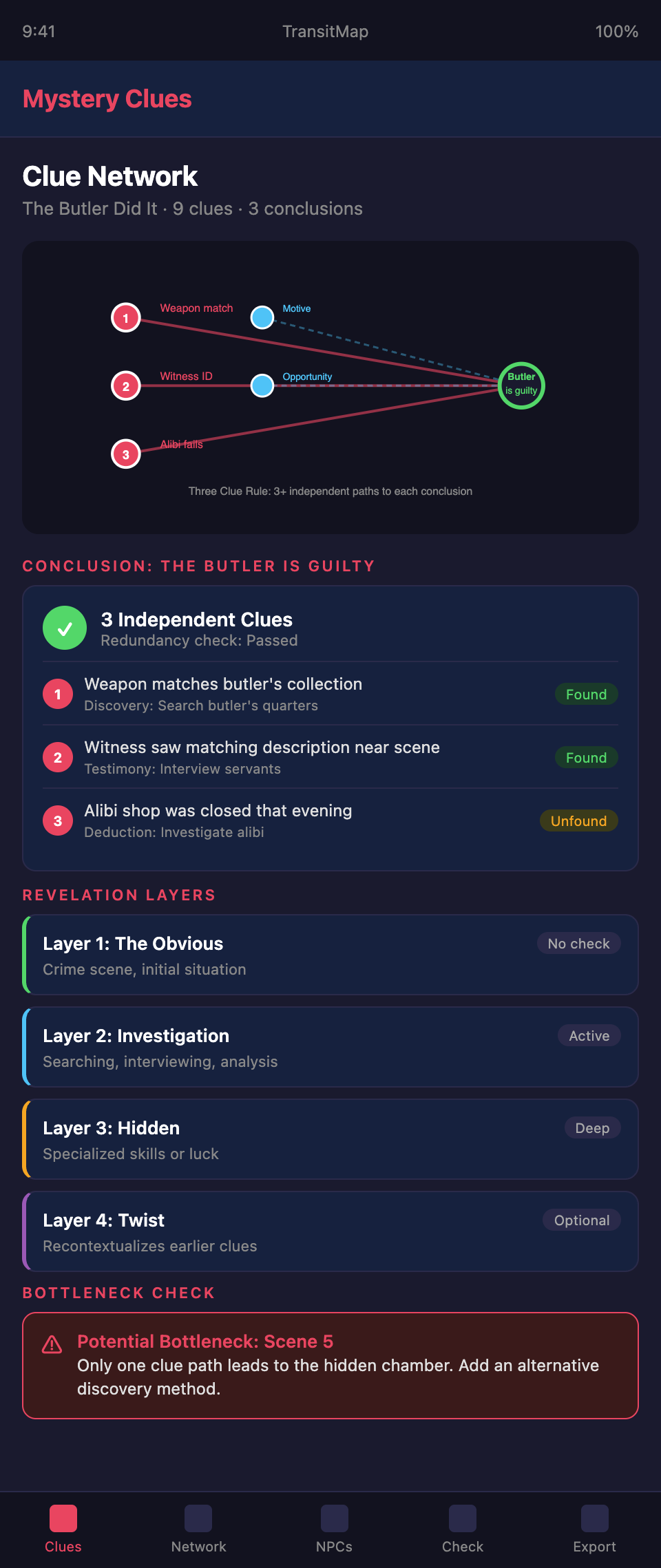
The most important principle in RPG mystery design: for every conclusion you want the players to reach, provide at least three independent clues that point to that conclusion.
Why three? Because players will likely miss at least one clue. They might not search the right location, ask the right question, or interpret the evidence correctly. With three clues, the probability of the players finding at least one approaches certainty.
Independent clues means each clue stands alone. If Clue B only makes sense after finding Clue A, they are not independent — they are a chain. Chains are fragile. Independent clues are resilient.
Example: The culprit is the butler.
- Clue 1: The murder weapon matches a blade from the butler's personal collection (found by searching the butler's quarters)
- Clue 2: A witness saw someone matching the butler's description near the scene (found by interviewing servants)
- Clue 3: The butler's alibi does not hold up — the shop he claims to have visited was closed that evening (found by investigating the alibi)
Each clue independently points to the butler. Missing any one or even two still leaves a path to the solution.
Clue Delivery Methods
Vary how clues reach the players to prevent investigation fatigue:
Discovery clues. Found by searching locations, examining objects, or observing the environment. These reward thorough players who investigate their surroundings.
Testimony clues. Obtained by talking to NPCs — witnesses, suspects, experts, or bystanders. These reward social players who engage with characters.
Deduction clues. Derived by combining two or more pieces of information. The timeline does not add up. The motive does not match the method. These reward analytical players who think critically.
Event clues. Delivered through events that happen during the investigation — the second crime, the attempt on the detective's life, the suspicious meeting. These keep the mystery active and prevent the investigation from becoming a static information-gathering exercise.
Mechanical clues. Revealed through skill checks, spells, or class abilities. A detect magic spell reveals an enchantment on the murder weapon. A survival check identifies the tracks. These reward players who use their character's abilities creatively.
Information Flow Design
Map the flow of information through your mystery:
The revelation sequence. In what order should the players ideally learn the key facts? Design the most likely discovery sequence, but do not require it.
Information nodes. Each location, NPC, and event in the mystery is an information node — a place where clues can be found. Map which clues are available at each node.
Redundancy check. For every critical conclusion, verify that at least three independent paths lead to it. If any conclusion has only one path, add redundant clues.
Bottleneck check. Identify any point where the investigation can only proceed through a single clue or interaction. These bottlenecks are where mysteries fail. Eliminate them by adding alternative paths.
The Revelation Structure
Design your mystery in layers of revelation:
Layer 1: The obvious. What anyone can see at the crime scene or initial situation. This information is available without investigation and establishes the mystery's parameters.
Layer 2: The investigation. What active investigation reveals. Clues that require searching, interviewing, or analysis. This layer constitutes the bulk of the mystery.
Layer 3: The hidden. Information that requires deep investigation, specialized skills, or luck to uncover. This layer provides the final pieces that resolve the mystery.
Layer 4: The twist. Optional information that recontextualizes earlier clues. The mystery seemed solved, but this layer reveals a deeper truth. Not every mystery needs a twist, but when included, it should be supported by clues available in earlier layers.
Managing Player Solutions
Players will form theories. Some will be correct. Some will be wrong. Some will be more interesting than the intended solution.
Do not block incorrect theories. Let players pursue wrong leads. The investigation should reveal that the theory is incorrect through evidence, not through GM fiat. "That is not what happened" is unsatisfying. "You investigate that theory and discover that the suspect was in a different city that night" is satisfying.
Support correct early solutions. If the players solve the mystery early, let them. Do not add obstacles to force them through your planned investigation sequence. Provide a path to confrontation and resolution whenever the players are ready.
Adapt to creative solutions. If the players develop a theory you did not plan for that fits the evidence, consider whether it could work. The best mystery adventures are flexible enough to accommodate player creativity.
Writing Mystery Modules for GMs
GMs running mysteries need more support than GMs running dungeon crawls:
Provide a complete clue list. A single reference page listing every clue, where it can be found, and what it reveals.
Provide an NPC knowledge matrix. A table showing what each NPC knows, what they will reveal freely, and what they will reveal only under pressure.
Provide investigation flowcharts. Visual maps showing how clues connect and which conclusions they support.
Provide fallback mechanisms. When the investigation stalls, provide tools for the GM: an NPC who approaches with information, an event that reveals a clue, or a mechanical ability that provides direction.
Designing a mystery module with complex clue networks? Join the TransitMap waitlist — map every clue, every NPC's knowledge, and every investigation path as a visual transit network that ensures your mystery is always solvable.