Planning Narrative Arcs for RPG Module Design
What Narrative Arc Means for Modules
A narrative arc is the shape of a story — how tension, stakes, and emotional engagement change over the course of the adventure. In fiction writing, the arc is controlled by the author. In an RPG module, the arc is a collaboration between the module designer, the GM, and the players.
Your job as a module designer is to create the scaffolding for the arc. You design the rising tension, the escalating stakes, the emotional beats, and the climactic encounter. The GM and players fill in the human elements — the specific choices, reactions, and improvisations that make each group's experience unique.
The Five-Beat Arc Structure
Most RPG modules benefit from a five-beat narrative structure:
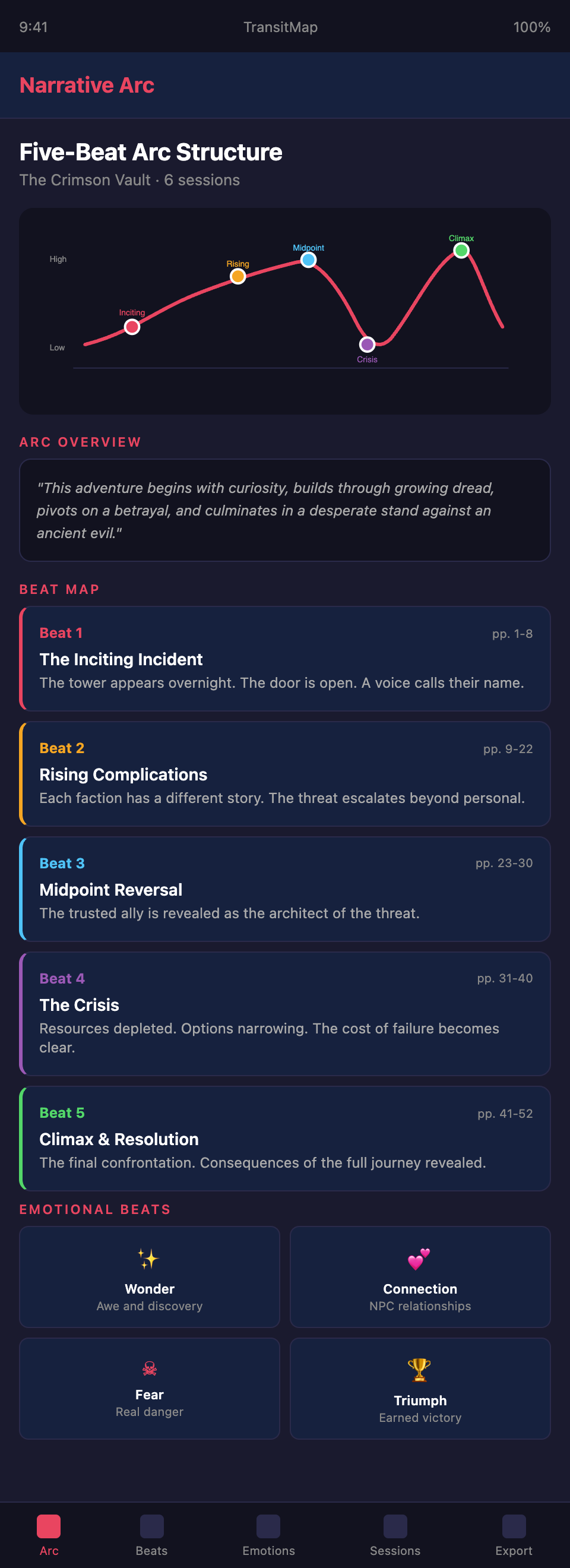
Beat 1: The inciting incident. Something happens that disrupts the status quo and demands response. This is your adventure hook in action — not just a reason to start the adventure, but an event that changes the characters' situation.
Beat 2: Rising complications. The situation proves more complex than expected. New information, new obstacles, new stakeholders. Each complication raises the stakes and deepens the characters' commitment to resolving the situation.
Beat 3: The midpoint reversal. Something changes fundamentally. The ally is revealed as an enemy. The objective turns out to be different from what was expected. The threat escalates dramatically. The midpoint reversal re-engages players who might be settling into routine.
Beat 4: The crisis. The characters face their greatest challenge before the climax. Resources are low. The situation is dire. The path forward requires sacrifice, risk, or difficult choice. The crisis is the emotional low point that makes the climax feel earned.
Beat 5: The climax and resolution. The final confrontation, revelation, or decision that resolves the adventure's central conflict. The climax should be the most intense experience in the module, and the resolution should show the consequences of the players' journey.
Designing Rising Tension
Tension does not rise automatically. You must design it:
Escalating stakes. Each major encounter should raise the stakes. The threat to a single person becomes a threat to a village, then to a region. The personal conflict becomes a political crisis. Stakes should escalate in scope, not just in difficulty.
Accumulating pressure. Give the players problems that accumulate rather than resolve sequentially. While they are solving Problem A, Problem B develops. When they address Problem B, Problem C emerges. The growing problem list creates pressure that drives the adventure forward.
Narrowing options. As the adventure progresses, the characters' options should narrow. Early in the adventure, many approaches are viable. By the climax, the characters are committed to a course of action with limited alternatives. This narrowing creates focus and urgency.
Revealing depth. The adventure should reveal increasing complexity. The simple quest reveals a conspiracy. The straightforward dungeon reveals a trapped civilization. Each layer of depth adds tension because the characters realize the situation is bigger than they thought.
Emotional Beats
Narrative arcs are not just about plot — they are about emotional experience:
The wonder beat. A moment of awe or discovery that reminds the players why adventuring is exciting. A breathtaking vista, an ancient wonder, a magical revelation.
The connection beat. A moment of genuine human connection between characters. An NPC's story resonates. A player character's backstory becomes relevant. A relationship deepens under pressure.
The fear beat. A moment of genuine threat where the players feel their characters are in real danger. Fear beats require mechanical teeth — if the players know they cannot actually lose, the fear is hollow.
The triumph beat. A moment where the players overcome a significant obstacle through clever play, good teamwork, or dramatic sacrifice. Triumph beats are earned, not given.
The consequence beat. A moment where the players see the results of their choices — for better or worse. Consequence beats validate player agency and make the adventure feel responsive.
Arc Planning for Multi-Session Adventures
Adventures spanning multiple sessions need arc planning at two levels:
The adventure arc. The overall shape of the complete adventure from first session to last. This follows the five-beat structure across the full adventure.
The session arc. Each individual session should have a mini-arc with its own tension curve. A session that is all rising tension with no peaks or valleys is exhausting. A session that is all plateau is boring.
Align session arcs with the adventure arc:
- Session 1: Inciting incident (session peaks at the hook reveal)
- Sessions 2-3: Rising complications (each session peaks at a complication reveal)
- Session 4: Midpoint reversal (session peaks at the twist)
- Session 5: Crisis (session peaks at the lowest point)
- Session 6: Climax and resolution (session peaks at the final confrontation)
Arc Documentation
Document your arc for the GM:
Arc overview. A one-paragraph description of the adventure's emotional journey — not the plot, but the feeling. "This adventure begins with curiosity, builds through growing dread, pivots on a betrayal, and culminates in a desperate stand."
Beat map. A simple diagram showing where each beat falls in the adventure's structure, with page references.
Emotional pacing notes. Brief notes at key points in the text: "This scene should feel ominous — the players are walking into danger they do not yet understand."
Planning your module's narrative arc? Join the TransitMap waitlist — map your adventure's emotional journey as a transit line with tension indicators, beat markers, and emotional pacing notes all visible on a single visual timeline.