Designing Sandbox Module Structures for Tabletop RPGs
The Sandbox Publishing Paradox
Sandbox adventures promise total player freedom. The players go where they want, do what they want, and the world responds. This is thrilling at the table and nearly impossible to publish.
A traditional module says: "Here is what happens." A sandbox module says: "Here is what could happen." The difference is fundamental. You cannot write a fixed sequence because there is no fixed sequence. Instead, you must provide the GM with a world, its moving parts, and the tools to run whatever the players decide to do.
The Sandbox Module Components
A publishable sandbox module needs five components:
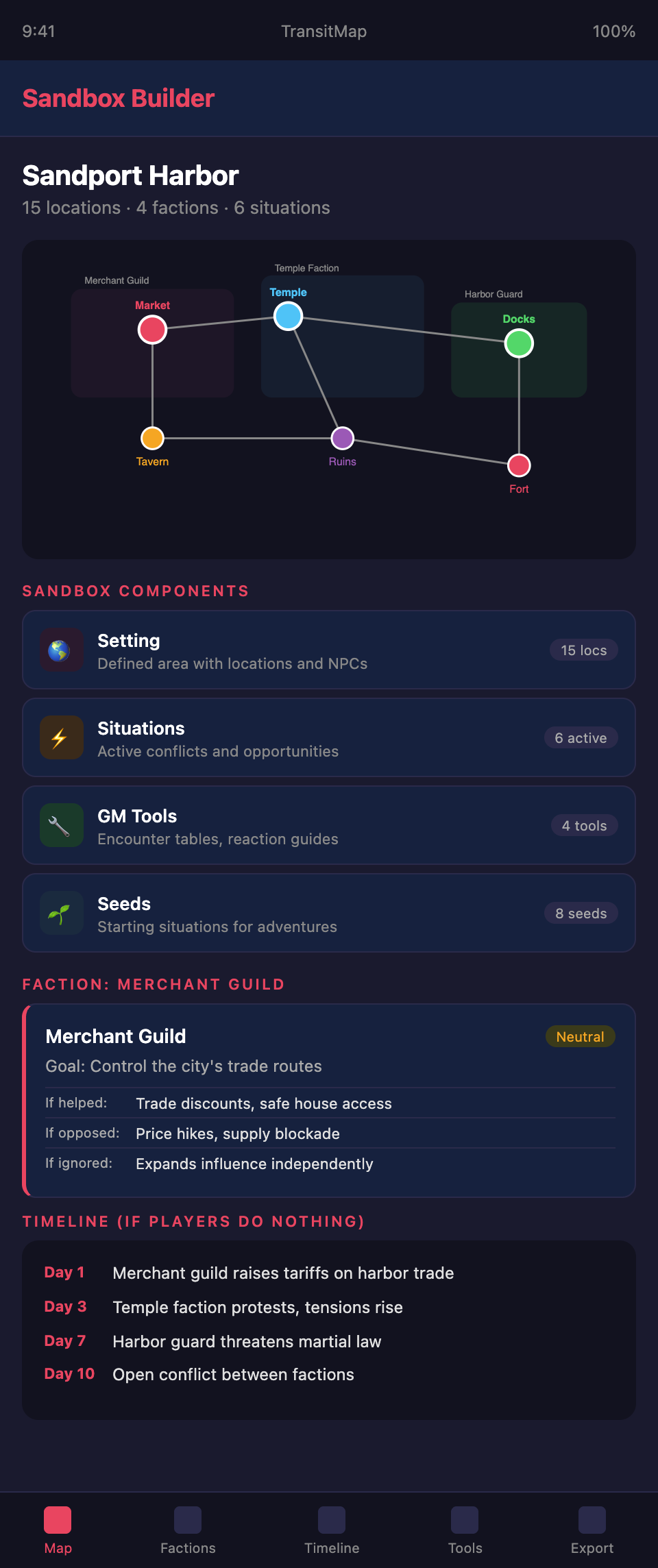
The setting. A defined area — a city, a region, an island, a space station — with locations, NPCs, factions, and points of interest. The setting is the sandbox itself.
The situations. Active conflicts, opportunities, and events happening in the setting independent of the players. These are not plot hooks — they are things happening that the players can choose to engage with or ignore.
The tools. GM resources for responding to player actions: random encounter tables, NPC reaction guidelines, faction response protocols, and consequence frameworks.
The seeds. Starting situations that can grow into adventures based on player interest. Seeds are not full adventures — they are premises that the GM develops through play.
The timeline. What happens if the players do nothing. How the situations evolve over time without player intervention. This gives the GM a baseline to modify based on player actions.
Designing the Setting
A sandbox setting needs to be detailed enough to run and open enough to adapt:
Location density. The setting needs enough locations to provide variety without overwhelming the GM. For a city sandbox, fifteen to twenty distinct locations is sufficient. For a regional sandbox, eight to twelve settlements or points of interest.
Location profiles. Each location needs:
- A description the GM can paraphrase for players
- One to three NPCs associated with the location
- One active situation or conflict at the location
- Connections to other locations (trade routes, rivalries, alliances)
The map. A sandbox setting requires a map. The map is the players' primary tool for deciding where to go. Include distances, terrain, and points of interest visible from the players' perspective.
Designing Situations
Situations are the sandbox's engine. They provide content without requiring player engagement:
Active conflict. Two or more parties in opposition. The merchant guild is undercutting the independent traders. The temple faction is restricting magic use. The neighboring kingdom is mobilizing troops. These conflicts exist whether or not the players involve themselves.
Ticking clocks. Events that will happen on a schedule unless the players intervene. The dam will break in three days. The festival begins next week. The ambassador arrives on the full moon. Ticking clocks create urgency and force decisions.
Opportunities. Chances for the players to gain resources, allies, or influence. A treasure map surfaces. A faction needs a favor. A competition is announced. Opportunities give players positive reasons to engage.
Mysteries. Unexplained phenomena that reward investigation. Strange lights in the forest. Ships disappearing in the harbor. A pattern of thefts that no one has connected. Mysteries appeal to curious players.
The Faction Web
Factions are the most powerful sandbox tool because they create a reactive world:
Define three to five factions with distinct goals, resources, and methods. Each faction should have:
- A clear goal that conflicts with at least one other faction's goal
- Resources they can deploy (people, money, information, force)
- A leader NPC the players can interact with
- A default attitude toward the players (friendly, neutral, hostile)
Faction response tables. For each faction, define how they respond to player actions:
- If the players help them: specific benefits and escalating alliance
- If the players oppose them: specific consequences and escalating hostility
- If the players ignore them: how the faction pursues its goals independently
Faction interaction. Define how factions interact with each other. When the players shift the balance by helping one faction, how do the others respond?
The Timeline
The timeline is what makes a sandbox feel alive:
Day-by-day or week-by-week events. Write a timeline of what happens in the setting if the players never arrive. Faction moves, natural events, NPC actions, external developments.
Branching timeline. At key points, the timeline should branch based on likely player interventions. "If the players prevent the assassination: the duke consolidates power. If the assassination succeeds: civil war begins."
Timeline flexibility. The timeline is a guide, not a script. The GM adjusts it based on player actions. But having a baseline prevents the world from feeling static between player interactions.
GM Tools for Sandbox Play
Random encounter tables that reflect the setting's current state. Different tables for different areas, different times of day, and different faction control zones.
NPC reaction guidelines. How do NPCs react to the players' reputation? Provide a simple system: faction reputation from -5 to +5, with behavioral guidelines at each level.
Consequence frameworks. When the players do something unexpected, the GM needs guidance on consequences. "If the players destroy the bridge: trade stops between the two districts, prices rise, the merchant guild blames the players."
Improvisation prompts. Brief scenario seeds that the GM can deploy when the players explore an area the module has not detailed: "A traveling healer asks for an escort. A collapsed building reveals an old basement. A child approaches claiming to have found something valuable."
Designing a sandbox module? Join the TransitMap waitlist — map your sandbox's locations, factions, and situations as an interconnected transit network, with timeline overlays and faction influence zones all visible on one interactive map.