Scaling Encounters for Different Party Levels in RPG Modules
Why Scaling Matters for Publishers
A module written for a specific level range excludes every group outside that range. A module with scaling guidance serves groups across a wider level band — which means a larger potential market and longer shelf life. Groups that outgrow the module's listed level can still use it with scaling adjustments.
Scaling guidance also demonstrates professionalism. It shows that the designer understands encounter balance and has thought through how the adventure's challenges work at different power levels. GMs trust modules that include scaling.
What Needs Scaling
Not everything in a module changes with party level. Focus scaling on elements that directly affect play:
Combat encounters. The most obvious scaling need. Enemy numbers, hit points, damage, special abilities, and tactical complexity all change with party level.
Skill check DCs. A DC 15 check is challenging for level 3 characters and trivial for level 10 characters. Provide DC ranges or formulas for level-appropriate difficulty.
Trap damage and DCs. Trap detection DCs, disarm DCs, and damage values all need scaling. A trap that is deadly at level 3 is an annoyance at level 10.
Treasure and rewards. Gold values, magic item rarity, and consumable quantities should scale with level. Under-leveled parties should not receive items intended for higher-level characters unless the items are narratively important.
NPC capabilities. NPCs who assist or oppose the party in non-combat ways (providing information, creating obstacles, offering services) may need adjusted capabilities at different levels.
What Does Not Need Scaling
Narrative content. The story, NPCs, motivations, plot structure, and emotional beats remain the same regardless of party level. Do not rewrite scenes for different levels — adjust only the mechanical elements.
Environmental challenges. Puzzles, social encounters, and exploration content are generally level-independent. A puzzle's solution does not change based on party level, though the consequences of failure might.
World-building. The setting, history, and lore are fixed regardless of who is playing. Do not create level-specific versions of world content.
Scaling Methods
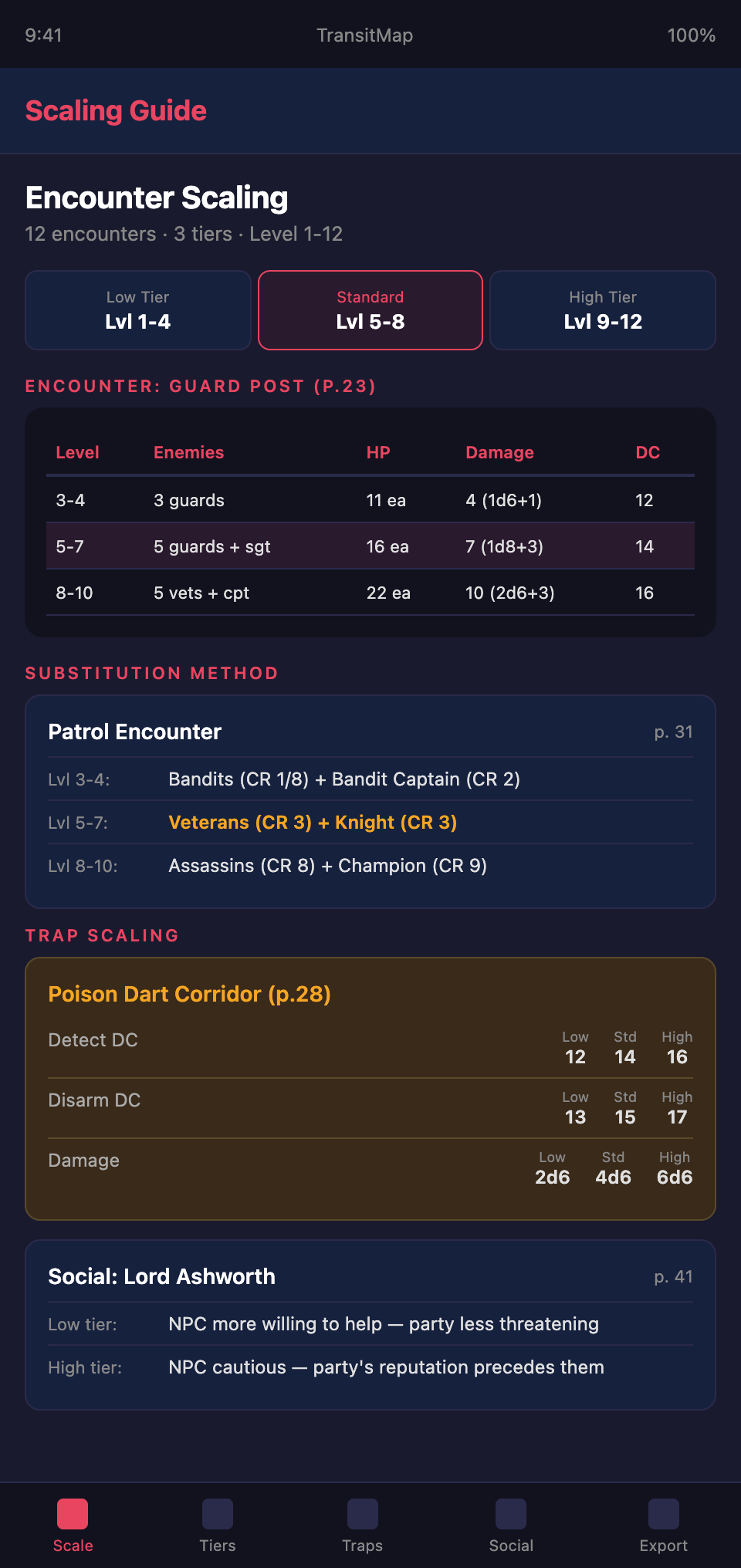
The tier system. Provide three tiers of encounter statistics:
- Low tier (levels 1-4): Fewer enemies, lower stats, simplified tactics
- Standard tier (levels 5-8): The module's default balance
- High tier (levels 9-12): More enemies, higher stats, advanced tactics
For each combat encounter, provide a stat summary for each tier.
The modifier system. Provide a base encounter and a set of modifiers:
- "For each level below 5: remove one enemy and reduce all DCs by 2"
- "For each level above 7: add one enemy and increase all DCs by 2"
This is simpler to present but requires more GM judgment.
The substitution system. Provide alternative creatures or NPCs for different level ranges:
- "Levels 3-4: Use bandits (CR 1/8) and a bandit captain (CR 2)"
- "Levels 5-7: Use veterans (CR 3) and a knight (CR 3)"
- "Levels 8-10: Use assassins (CR 8) and a champion (CR 9)"
This is the most detailed approach and produces the best-balanced results.
Presenting Scaling Information
Scaling tables. For each encounter, include a scaling table:
| Party Level | Enemies | Enemy HP | Damage | DC |
|---|---|---|---|---|
| 3-4 | 3 guards | 11 each | 4 (1d6+1) | 12 |
| 5-7 | 5 guards + sergeant | 16 each | 7 (1d8+3) | 14 |
| 8-10 | 5 veterans + captain | 22 each | 10 (2d6+3) | 16 |
Inline scaling notes. Brief adjustments within the encounter text: "The chamber contains four skeleton warriors (six for parties of level 8+; two for parties below level 5)."
Appendix scaling guide. A comprehensive scaling reference in the appendix that covers all encounters in the module. This consolidates scaling information for GMs who want to review all adjustments at once.
Scaling Traps and Hazards
Traps need three scaled elements:
Detection DC. The difficulty of finding the trap. Scale by 2 per tier: DC 12 for low tier, DC 14 for standard, DC 16 for high tier.
Disarm DC. The difficulty of disabling the trap. Follow the same scaling as detection, or slightly higher if the trap is meant to be challenging to disarm.
Damage. Scale trap damage to represent a meaningful but not overwhelming threat at each tier. A trap that deals 2d6 damage at low tier might deal 4d6 at standard and 6d6 at high tier.
Scaling Social Encounters
Social encounters scale differently from combat:
NPC attitude adjustments. At lower levels, NPCs might be more willing to help — the party is less threatening and more sympathetic. At higher levels, NPCs might be more cautious — the party's reputation precedes them.
Information availability. At lower levels, provide information more freely to compensate for fewer investigative resources. At higher levels, make information harder to obtain because the party has more tools to extract it.
Consequence severity. Failed social encounters at lower levels should have softer consequences. At higher levels, social failures can have more dramatic repercussions because the party has more resources to recover.
Testing Scaled Encounters
Test at each tier. Playtest or theoretically analyze encounters at each scaling tier. Balance issues that do not exist at standard tier may emerge at low or high tier.
Test boundary levels. Test at the transition points between tiers — the levels where the scaling changes. These are where balance is most likely to break.
Designing a module with scaling for multiple level ranges? Join the TransitMap waitlist — map encounter scaling tiers visually across your adventure's structure, ensuring balanced play at every level with difficulty indicators at every stop.