Writing Compelling Adventure Hooks for RPG Modules
What a Hook Actually Does
An adventure hook is not a summary of the adventure. It is a promise. It tells the GM: "If you run this, here is the experience your table will have." It tells the players: "Here is why your characters would care about this."
A hook operates at two levels simultaneously:
The GM level. The GM reads the hook during prep and decides whether to use the module. The hook must convince the GM that the adventure is worth running — that it will produce memorable moments, interesting choices, and satisfying gameplay.
The player level. The GM delivers the hook to players in-game to launch the adventure. The hook must give the characters a compelling reason to engage with the adventure's content.
Many module hooks only work at one level. They intrigue the GM but give the characters no reason to act, or they provide an in-game motivation but fail to excite the GM about running the content.
The Hook Formula
Effective hooks share a common structure:
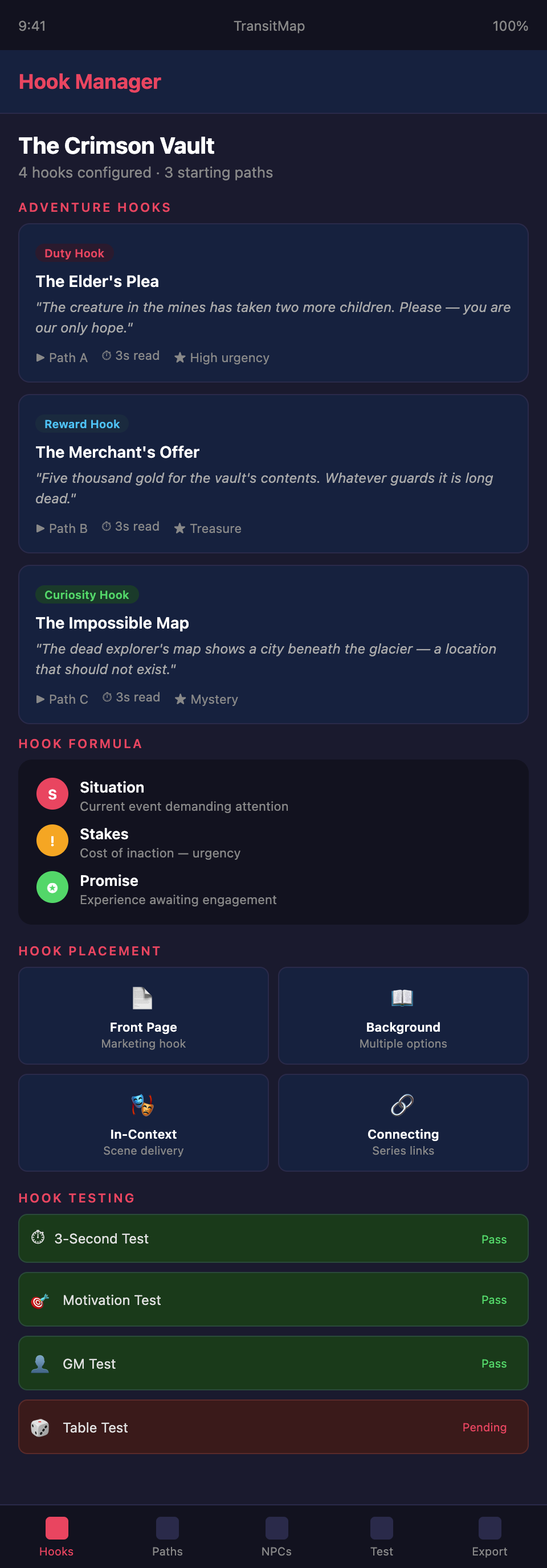
Situation. What is happening right now that demands attention? Not backstory. Not context. The current situation that the characters encounter.
Stakes. What happens if the characters do nothing? The threat, the cost, the consequence of inaction. Stakes create urgency.
Promise. What experience awaits the characters who engage? Adventure, treasure, justice, discovery, revenge. The promise tells players what they are signing up for.
Example — Weak hook: "Long ago, the wizard Kaelen built a tower in the northern wastes. He studied forbidden magic and eventually disappeared. Recently, travelers have reported strange lights from the tower."
Example — Strong hook: "The wizard's tower appeared overnight in the field north of town — a tower that has been missing for three hundred years. The door is open. From inside, a voice calls your name."
The weak hook is backstory. The strong hook is a situation with immediate stakes and a compelling promise.
Multiple Hooks Per Adventure
Provide at least three hooks for each adventure, each appealing to different player motivations:
The duty hook. Appeals to characters motivated by responsibility, protection, or justice. "The village elder begs for help — the creature in the mines has taken two more children."
The reward hook. Appeals to characters motivated by treasure, power, or advancement. "The merchant offers five thousand gold for the contents of the sealed vault — and assures you that whatever is guarding it is long dead."
The curiosity hook. Appeals to characters motivated by knowledge, exploration, or mystery. "The map you found in the dead explorer's pack shows a location that should not exist — a city beneath the glacier."
The personal hook. Appeals to characters with specific backstory connections. Provide prompts that the GM can customize: "One character recognizes the symbol on the message — it belongs to someone from their past."
By providing multiple hooks, you give the GM options to match the adventure's introduction to their specific table's motivations.
Hook Placement in the Module
Where and how you present hooks affects their usability:
Front page hook. A one-paragraph hook on the first page or back cover that sells the adventure to the GM browsing a store or online listing. This is your most important marketing text.
Adventure background hooks. In the adventure's introduction, present the multiple hooks with clear labels. The GM should be able to choose their preferred hook at a glance.
In-context hooks. Within the adventure text, include specific scenes or encounters that deliver the hook in play. Do not just describe the hook — write the scene: the NPC's dialogue, the discovery of the map, the arrival of the messenger.
Connecting hooks. If your adventure is part of a series or is designed to follow another module, provide hooks that connect the adventures: "If the party completed The Sunken Temple, the gem they recovered begins to glow..."
Writing Hook Dialogue
When a hook involves an NPC delivering information to the players, write the dialogue:
Do not write: "The innkeeper tells the party about the haunted manor on the hill."
Write: "The innkeeper leans close, lowering his voice: 'I do not tell this to just anyone. The manor on Greyhill — the one with the iron gates? My daughter went up there on a dare last week. She came back different. She will not tell me what she saw, but she has not slept since.'"
Written dialogue gives the GM a performance to deliver, not just information to convey. It sets the tone, reveals the NPC's personality, and creates an emotional hook beyond the plot hook.
Hook Testing
Test your hooks before publication:
The three-second test. Can someone read the hook in three seconds and want to know more? If the hook requires multiple reads to generate interest, it is too complex.
The motivation test. After reading the hook, can the reader identify why characters would engage? If the answer is "because the adventure requires it," the hook is failing.
The GM test. Show the hook to GMs and ask: "Would you run this?" Their response tells you whether the hook is selling the adventure.
The table test. Deliver the hook to a playtest group in character. Note their reaction. Excitement and immediate action mean the hook works. Confused questions and reluctant engagement mean it needs revision.
Writing hooks for a branching adventure where different hooks lead to different starting paths? Join the TransitMap waitlist — map how each hook connects to the adventure's branching structure, ensuring every entry point leads to a compelling experience.